Chesky — People who know what to build with AI will pull ahead (Silicon Valley Girl, Oct 2026)
▶ Watch on YouTube · Silicon Valley Girl · 34:44
I spoke with Brian Chesky, Co-Founder & CEO of Airbnb, about how AI is changing the way people build companies, launch ideas, and stand out in a world where everyone has access to the same tools.
— channel description, Silicon Valley Girl (first line; links, sponsor copy and chapter list omitted)
TL;DR
A ~35-minute interview on Silicon Valley Girl, the YouTube channel of Marina Mogilko, published 1 October 2026. The guest is Brian Chesky, co-founder and CEO of Airbnb. It was recorded on the day of an Airbnb product launch (“starting today”), and the editors cut in Airbnb’s own product visuals, eight of which are published below. The episode is sponsored by HubSpot (an ad read at 12:00–12:51). The captions are auto-generated; quotes are cleaned for names only.
1. “AI-native” means every touch point gets smarter (1:52–4:50). The launch: an AI search toggle that takes natural language and “will also prefilter everything for you because Airbnb is very much about filters and controls”; AI-generated highlights that summarise a listing “personalized to you”; asking the listing page a question instead of the host; an AI comparison tool; neighbourhood maps (Paris first, “eventually … a thousand different cities”). On the host side the app will “feel more and more like an agent that can be your coach.”
2. An agent is not a chatbot (2:49–5:40). “Chat bots aren’t really great for shopping. Chat bots aren’t really good for travel”: they are text-based, hard to compare, not visual, not “multiplayer” (the average Airbnb booking is three people). “Agent is an evolution of an application … A chatbot is a user interface. And I think because most agents are chatbots, we conflate the two.” And: “the great thing about agents is they’re interoperable. So one agent can talk to another agent.” See ai-agents.
3. A travel graph instead of a social network (5:59–8:35). Social media has become “performance platforms … broadcast platforms”; Airbnb lets you connect with friends and see where they have stayed, because “increasingly people want recommendations [from] their friends and their family rather than from … celebrities or writers.” The aim is to turn Airbnb “from … just a marketplace of homes to a little more of a travel community.”
4. Shipping 80% more features (8:36–10:16, 17:48–18:00). “We’re shipping 80% more features than a year ago. Most of it’s because of AI. … It used to take us a year to ship like a new service, now we can do it in weeks.” Services now include baby gear, laundry, ski equipment, groceries via Instacart. No method or baseline is given for the 80%.
5. Services as a long tail (10:17–16:54). A masseuse in Tulum or a photographer at the Eiffel Tower gets “a global audience of travelers”, as hosts once did for homes. Services are tested “in one market, one city. If it works, then we bring it to other markets.” The opportunity is the long tail: most services are “not big enough to have a global brand” or an app.
6. Token leaderboards were a phase; measure product velocity (16:55–17:52). Early in the year “CEOs were telling everyone, you got to use AI and they were measuring it by how many tokens you were using … There were like token leaderboards.” That “might have been a good thing to do for a couple months”, but “now all of a sudden everyone’s like, ‘Wait a second. Why are we spending so much money on AI?‘” Airbnb looks at “product velocity. How fast are you shipping? How many features … Are they high quality? And are they successful?”
7. Same tools, unequal results (17:53–20:03). “AI is the ultimate democracy. The tools that Airbnb has is the tools every company in the world has”, like Photoshop for designers, “but they’re not equally distributed.” The gain is “two things … the power of AI … but it’s also cultural. People have to use the tools and they have to use them correctly.” “AI is like an amplifier. It makes the good people better and the people that weren’t as good, it’s less of a multiplier for them. … The performance gap is greater with AI.” What matters now: “it’s no longer can you build it. It’s what do you build and … should you build it.”
8. Idea volume, and AI as the reader of his notebook (20:04–25:46). Quoting Linus Pauling (“the best way to have a good idea is to have a lot of ideas”), he writes about a thousand words a day, bolds the lines that stand out, and “at the end of every month … my AI now can just read the bold ideas … it can see patterns.” “Good ideas don’t die”: they come back. Examples from Da Vinci, Van Gogh and Hemingway.
9. Blinders, and the big screen (25:47–29:13). Less time on X: “now it’s Instinct, now it’s Muse … we’re all like kids chasing soccer balls.” Ten to thirty minutes a day of keeping up is enough. “Attention span is commensurate with screen size. … Do not look at a phone if you want to focus.”
10. Chat is the wrong interface for most work (29:14–31:40). If he were 26 now he would look at education, “an AI Disney” or health. Instinct and Muse are “the beginning of consumer AI, agentic AI, but I do not think that the messaging interface is the right interface to do most work.” Fitting AI into messaging “is like putting a jet engine on the back of a bicycle.”
11. “There’s going to be 50 more Anthropics, maybe a hundred” (31:40–34:05). “This is a cognitive revolution … We’re not in a window. And if we are, it’s a thousand-year window”, with “millions of small companies” because “one, two or three people can start a whole business.” On fear outside Silicon Valley: AI “is changing their job. It’s displacing them. And some of that may be true … But I am saying that everyone has the power now.” His own start with Claude Code: an employee tutored him. “Jump in the pool … the water is not cold. It just looks cold.”
Visual canon
Gemini found 22 visuals. Eight are published: seven views of Airbnb’s launch, which show what the narration describes in general terms, and one definition card. Dropped: an untitled listing view (2:03), a duplicate services screen (15:01), nine biography cards (Pauling, IDEO, Eminem, Dylan, Jay-Z, Da Vinci, Mona Lisa, Van Gogh, Hemingway, Steve Jobs), and the channel’s newsletter promo. The “Muse” card at 26:13 was mistimed: the frame shows the host. All product visuals are Airbnb’s own launch material and show designed examples, not usage data.
1 · AI search toggle
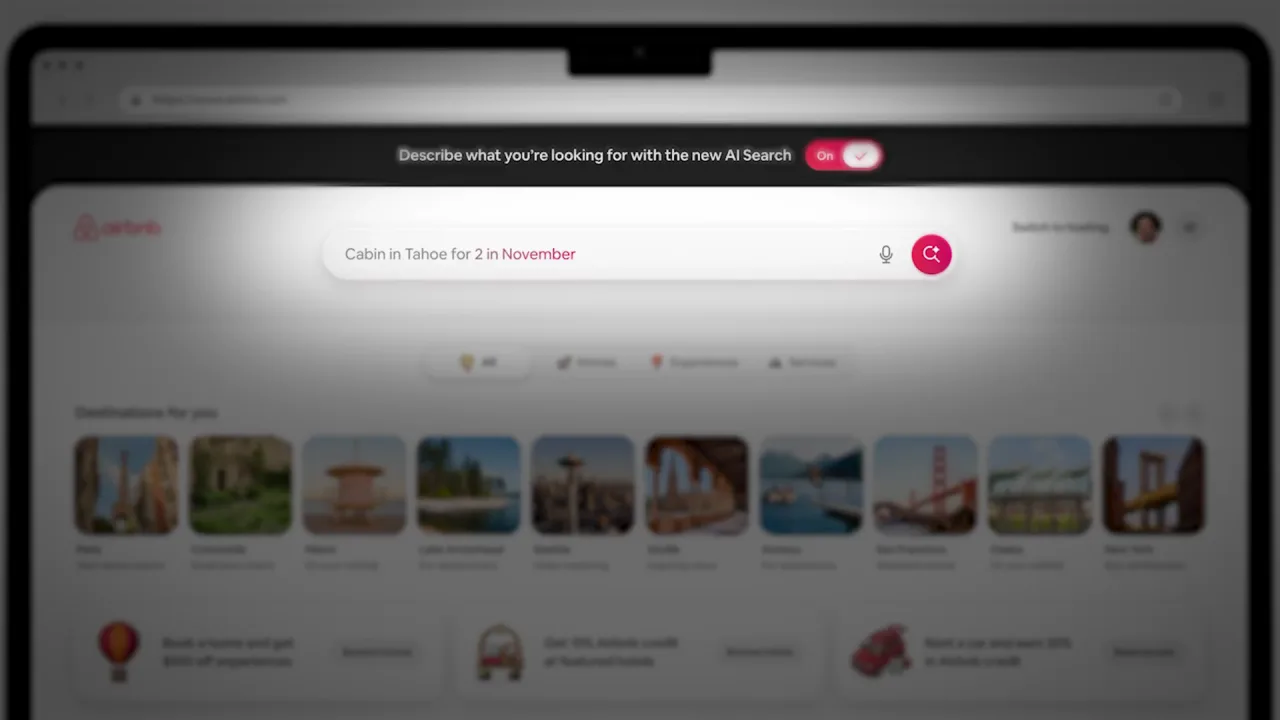
Still at 2:29 from Silicon Valley Girl, “Brian Chesky: People Who Know What to Build With AI Will Pull Ahead”.
Banner: “Describe what you’re looking for with the new AI Search” — toggle On. Query: “Cabin in Tahoe for 2 in November”, with a microphone icon.
Still vs. transcript: the search is a toggle on the existing page, not a separate chat window, which is Chesky’s point about keeping filters.
2 · AI-generated highlights
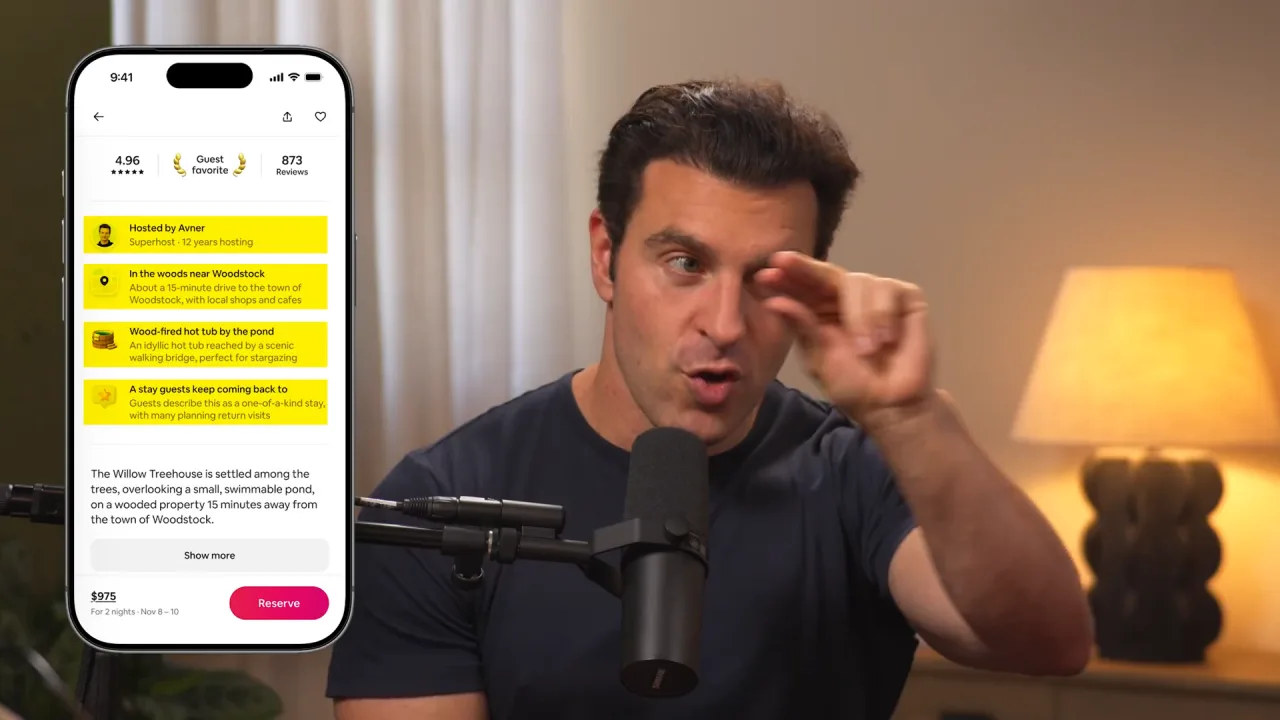
Still at 3:35.
Listing (4.96 · Guest favorite · 873 reviews), four highlighted lines: Hosted by Avner (Superhost · 12 years hosting) · In the woods near Woodstock · Wood-fired hot tub by the pond · A stay guests keep coming back to (“Guests describe this as a one-of-a-kind stay, with many planning return visits”). $975 for 2 nights.
Still vs. transcript: the last highlight is a summary of the reviews, not of the host’s text.
3 · Compare
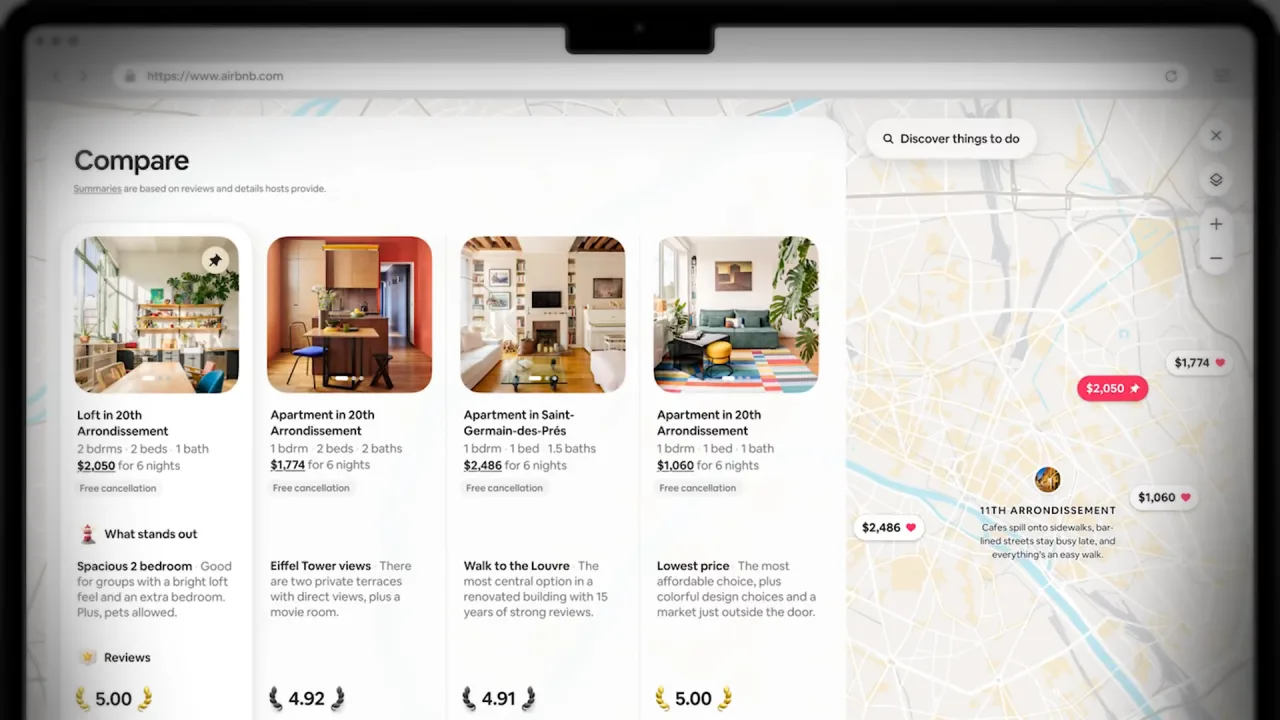
Still at 4:01.
“Summaries are based on reviews and details hosts provide.” Four Paris listings side by side with a What stands out row: Spacious 2 bedroom · Eiffel Tower views · Walk to the Louvre · Lowest price; then review scores (5.00, 4.92, 4.91, 5.00). Map at right with prices and an 11th Arrondissement note.
Still vs. transcript: the disclaimer line states the summaries’ sources, which the narration does not.
4 · Neighbourhood map
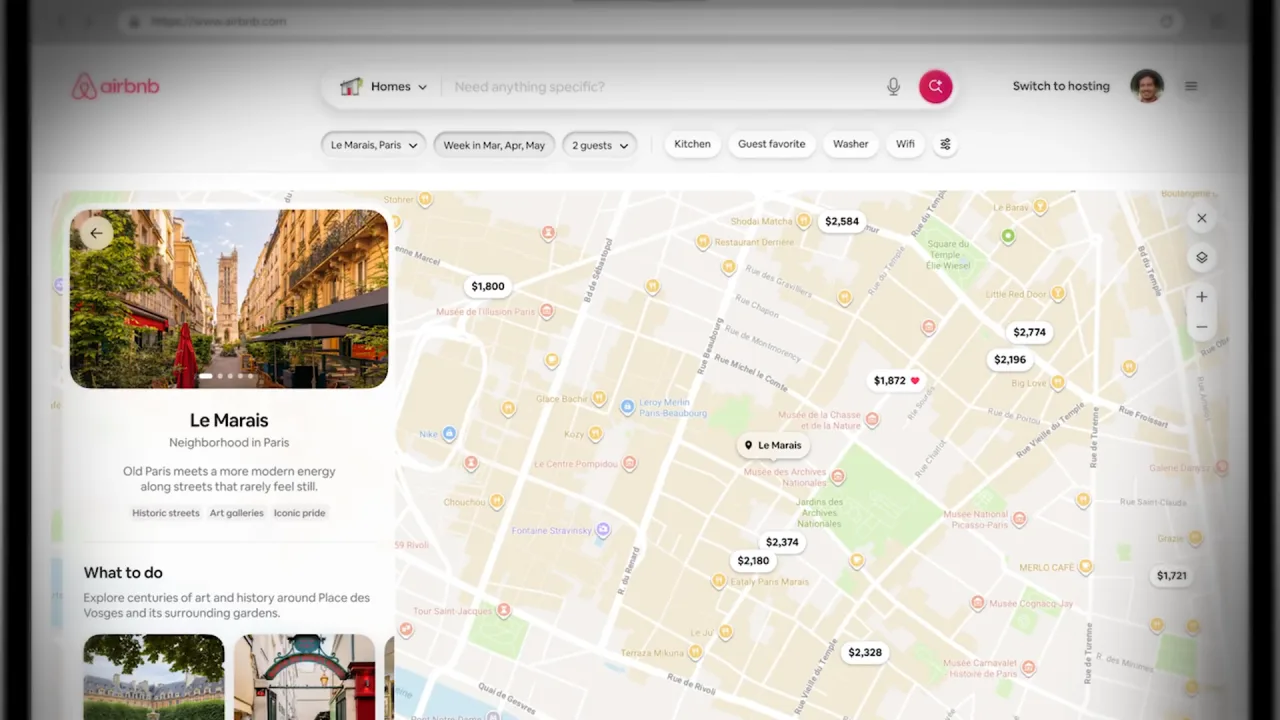
Still at 4:34.
Le Marais · Neighborhood in Paris — “Old Paris meets a more modern energy along streets that rarely feel still.” Tags: historic streets, art galleries, iconic pride. What to do: “Explore centuries of art and history around Place des Vosges.” Prices on the map.
Still vs. transcript: shows the neighbourhood descriptions are written copy attached to the map, not a chat answer.
5 · Travel map
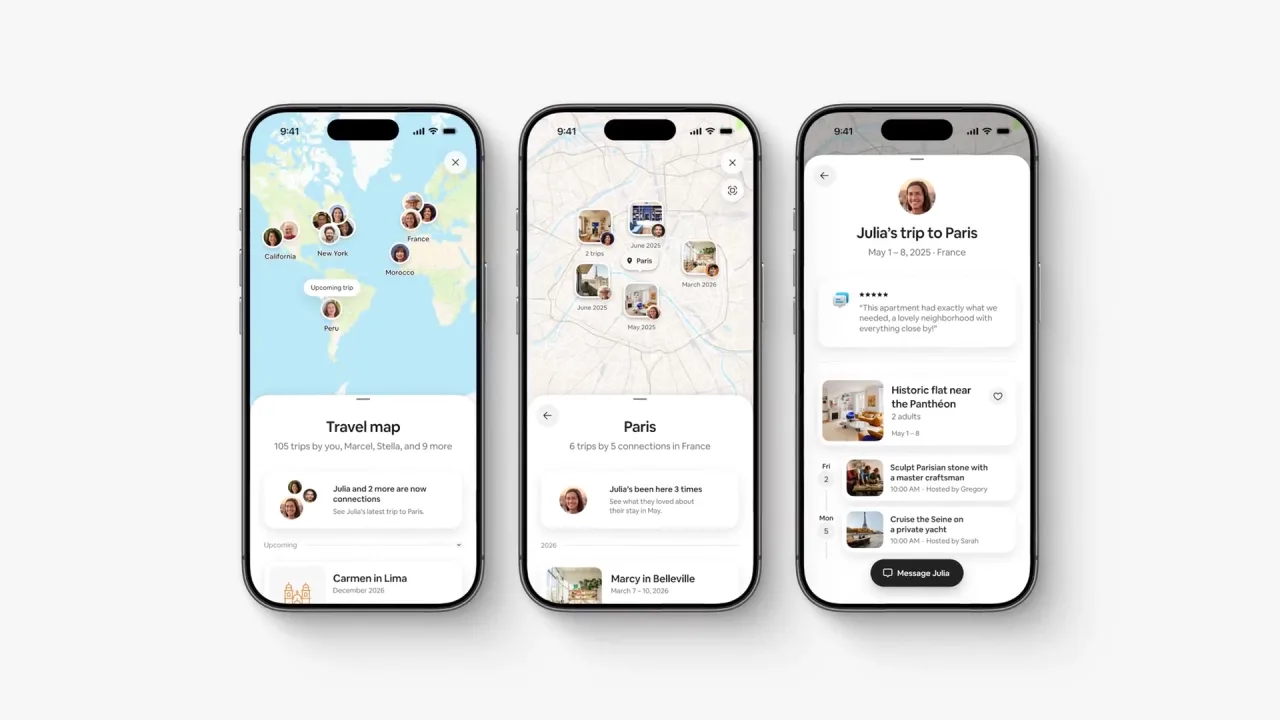
Still at 7:09.
Three screens: Travel map — 105 trips by you, Marcel, Stella, and 9 more; Paris — 6 trips by 5 connections in France (“Julia’s been here 3 times”); Julia’s trip to Paris with her review, the flat and two experiences, and a Message Julia button.
Still vs. transcript: shows the graph exposes friends’ reviews and booked experiences, not only where they stayed.
6 · Services in the trip view
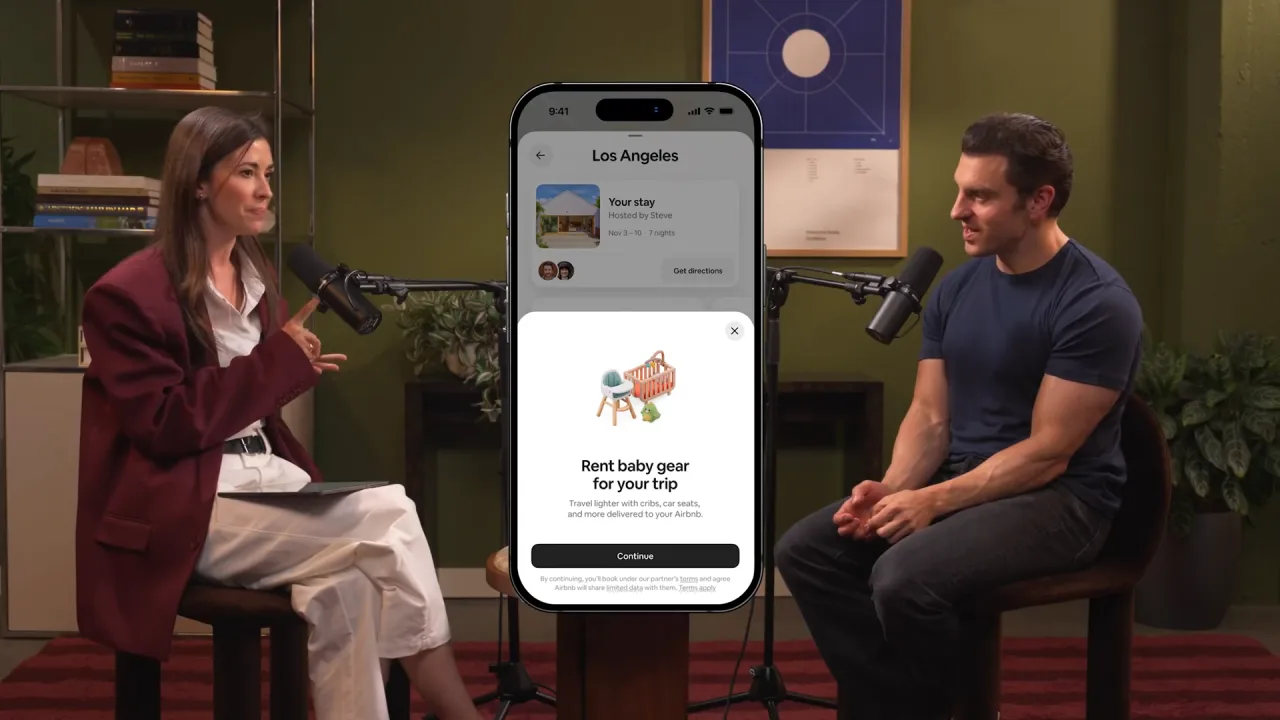
Still at 8:43.
Trip Los Angeles · Your stay, hosted by Steve; sheet: “Rent baby gear for your trip — Travel lighter with cribs, car seats, and more delivered to your Airbnb.” Fine print: “By continuing, you’ll book under our partner’s terms and agree Airbnb will share limited data with them.”
Still vs. transcript: the fine print shows these services run through partners, with data shared, which Chesky does not mention.
7 · Services marketplace
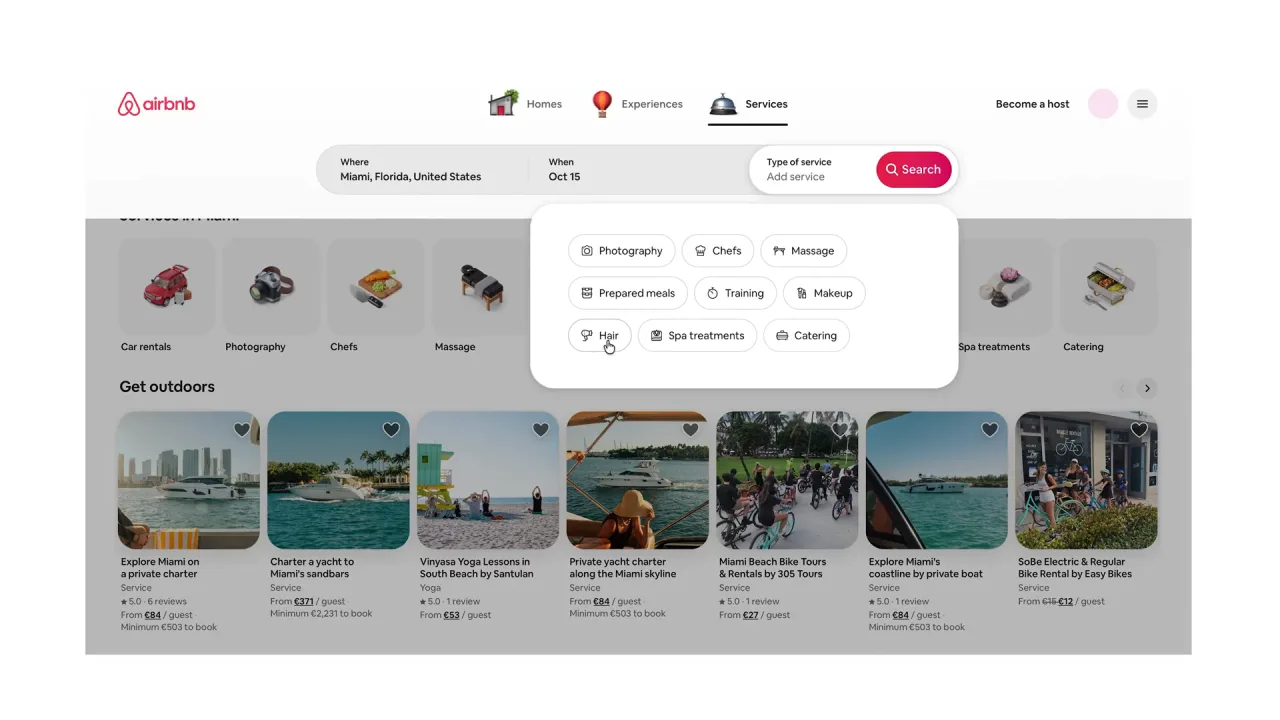
Still at 15:35.
Tabs Homes · Experiences · Services. Search Miami, Florida · Oct 15 · Type of service: Photography, Chefs, Massage, Prepared meals, Training, Makeup, Hair, Spa treatments, Catering. Listings below: private charters, yoga, bike tours.
Still vs. transcript: the actual categories on offer, against the narration’s open-ended “anything you can imagine”.
8 · “Instinct”
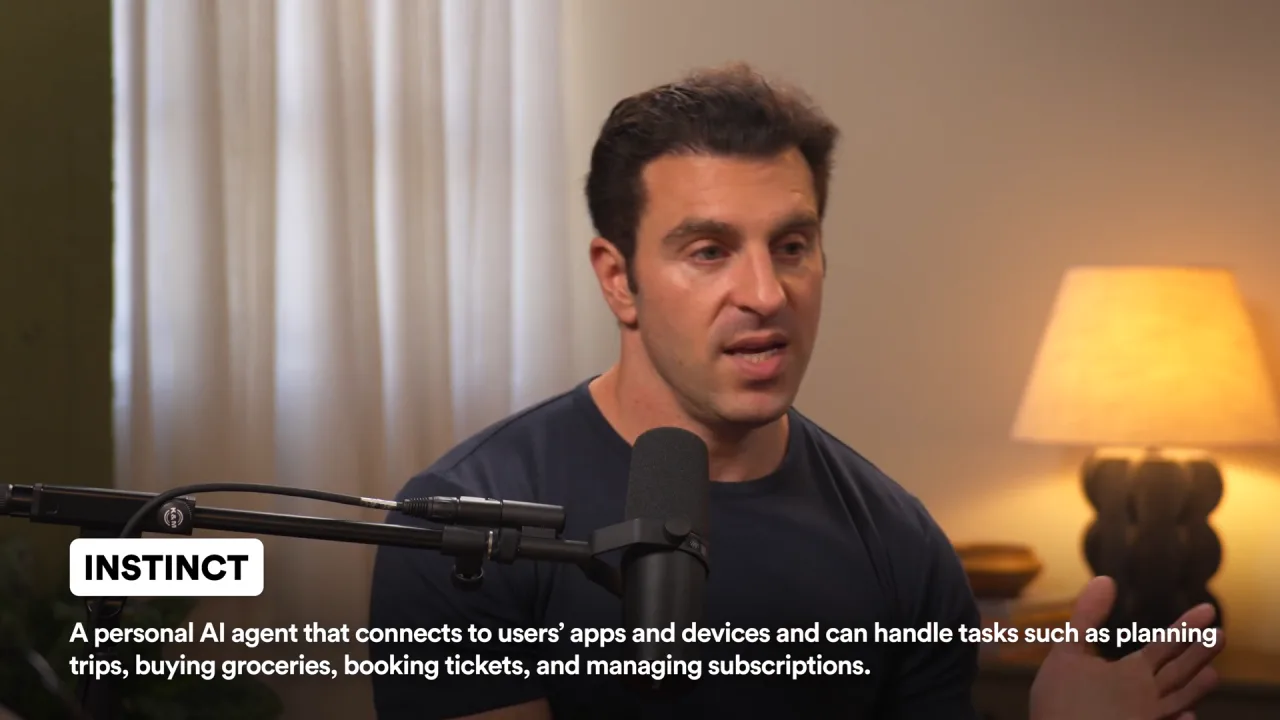
Still at 26:06.
INSTINCT — “A personal AI agent that connects to users’ apps and devices and can handle tasks such as planning trips, buying groceries, booking tickets, and managing subscriptions.”
Still vs. transcript: Chesky names Instinct twice without saying what it is; the channel’s card supplies the definition. It is the editor’s gloss, not Chesky’s.
Dynamic-capabilities reading
- digital-seizing/rapid-prototyping — services are tested in one city before rollout, and AI cut the time to ship a new service from a year to weeks.
- strategic-renewal/business-model — the stated move from a marketplace of homes to a services platform and “travel community”, with small service providers as the new supply side.
- digital-transforming/improving-digital-maturity — the 80% gain is put down to tools and culture: Airbnb trained people to use the tools correctly, and dropped token counts for product-velocity metrics.
Related in this wiki
- DORA 2025 calls AI an amplifier of what a team already is; Chesky says the same of individuals.
- Lukic & Goydan (BCG) name the token-counting phase “tokenmaxxing”; Chesky describes the same phase and what replaced it at Airbnb.
- Brynjolfsson, Li & Raymond found the largest gains among weaker, newer support agents, the opposite of Chesky’s amplifier claim (see Debates).
- Collison (Browserbase) discusses agents buying on the open web, from the payments side; Chesky argues for agents that are not chatbots, from the marketplace side.
- Mollick (HBR) and the Melbourne survey, from the same ingest batch, discuss who uses AI well and why.
Linked entities and concepts
- Entities: Silicon Valley Girl (channel), HubSpot (sponsor), Anthropic (named).
- Concepts: ai-agents, enterprise-ai-adoption, ai-coding-productivity-evidence, durable-skills.
- Dangling (single-source mention, deferred): Brian Chesky, Marina Mogilko, Airbnb.
Debates and supersession
- Amplifier or leveller? Chesky: “the performance gap is greater with AI.” Brynjolfsson, Li & Raymond measured the reverse in customer support: the biggest gains for the least experienced. The two differ in evidence (a CEO’s observation vs a field study) and in work (product design and engineering vs scripted support).
- The 80% figure has no baseline, method or definition of “feature”. Treat it as a vendor claim.
What was actually ingested
The full 34:44 episode from YouTube’s auto-generated English captions, fetched through the transcript panel, with chapter headings from YouTube. Names in quotes are corrected (Chesky, Instinct, Instacart, Claude Code). The Gemini still scan found 22 visuals; all were viewed and 8 are published.