DW News — Estonia: Why young people can’t find entry-level jobs (Oct 2026)
▶ Watch on YouTube · DW News · 4:50
Estonia has more start-up unicorns per capita than almost any country in Europe. Yet for young people here, landing a first job is harder than ever — one in five remains unemployed.
— channel description, DW News (chapter list and links omitted)
TL;DR
A 4:50 television news report from DW News, published 1 October 2026, with manual English captions. It follows two young job seekers in Tallinn and puts their search against Estonian and EU youth unemployment figures. It is a report, not an analysis. AI is one of five reasons given, and it comes from a single employer’s opinion; the source contains no measurement of AI’s effect. The page is in the wiki as a European, non-US data point on the entry-level question that ai-employment-effects tracks mostly with US evidence.
The figures, as stated:
- Youth unemployment in Estonia “above 20%” in 2026. The chart shows 22.7% (ages 15–24) against an EU average of 15.5% (Eurostat, June 2026).
- Overall unemployment in Estonia is “just 6.6% in the second quarter of 2026.”
- Estonia is “home to ten unicorn companies.”
The reasons the report gives, in order:
- Experience demanded up front. Steven, a finance graduate, has applied for four months. He finds two to ten junior postings a month that need “no experience… whatsoever,” and says “you have to come into a company or interview with proof that you’re very good at your job… This is the hardest part — just finding a job where they could teach you how to be a professional at something.”
- Startups import talent. Nelja Kornfeld (HR expert, recruitment partner at ProCareer) says scale-ups such as Bolt and Wise “bring a lot of people from abroad… because we don’t have professionals to match their needs.”
- Mismatched expectations. Kornfeld again: juniors “want more work-life balance, while [employers] expect full commitment.” Keishy Margus, head of talent acquisition at Elisa Eesti, sees the flexibility demand as legitimate: “It also requires some employers to adapt.” Elisa says 22% of its roughly 1,000 Estonian employees are Gen Z.
- AI takes the repetitive entry tasks. Margus: “When we think of 10 or 20 years back, entry level jobs were those simple jobs where you did some repetitive tasks. But today we know that automation and AI do those repetitive tasks, so companies may not need a person for that.”
- Language requirements. Varvara, born in Estonia but not fluent in Estonian (one in five residents has Russian roots), says “almost every single job requires you to have Estonian skills, at least B1.” She is taking language courses through Estonia’s Unemployment Insurance Fund.
The institutional point. The narrator says “institutional design matters more than national wealth”. Germany and the Netherlands “owe their low rates to strong dual apprenticeship systems that combine on-the-job training at a company with theoretical instruction,” while some wealthy countries are above the EU average. The chart shows both: the two countries highlighted at the low end, and Finland and Sweden above Estonia.
Visual canon
The Gemini scan found one chart, shown in two build states. The fully built one is published. Gemini read the source line as “Eurostat, June 2024”; the pixels say June 2026.
1 · Youth unemployment across the EU
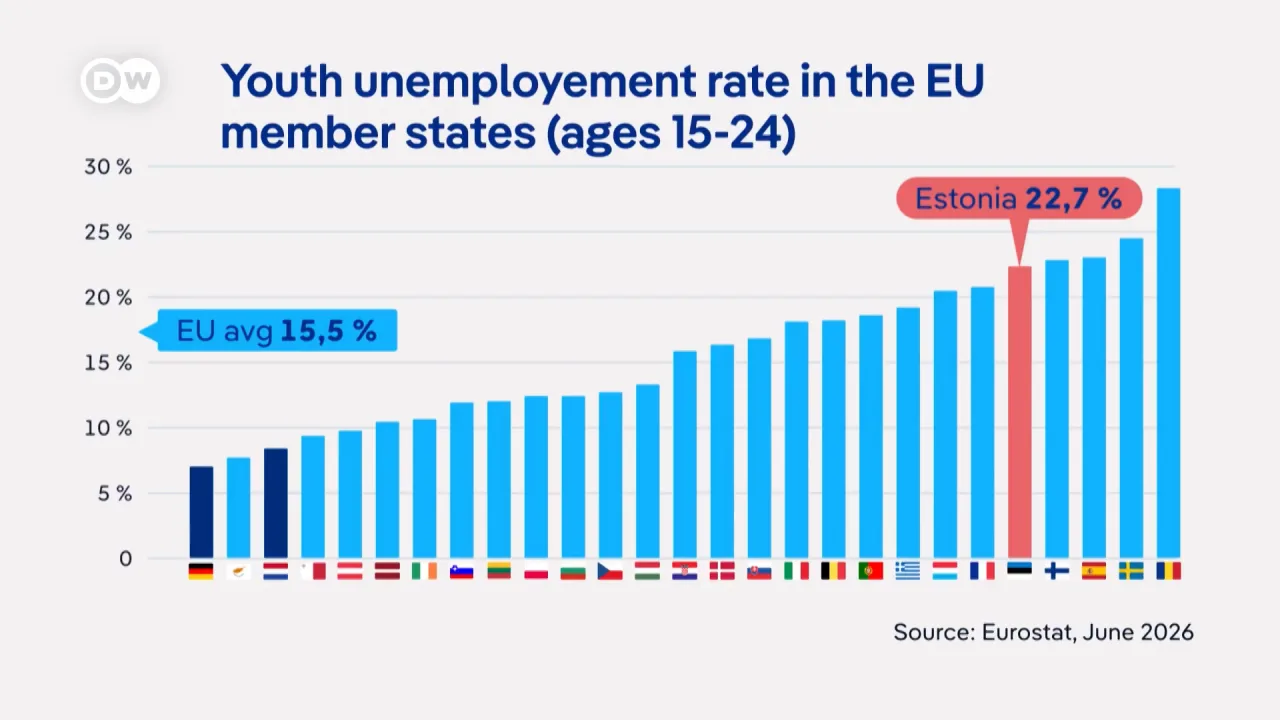
Still at 3:49 from DW News, “Estonia: Why young people can’t find entry-level jobs”.
Youth unemployement rate in the EU member states (ages 15-24) (the slide’s spelling) — 27 bars in ascending order, labelled only by flag. Two labels: EU avg 15,5 % and Estonia 22,7 %. Germany (lowest, about 7%) and the Netherlands (third, about 8.5%) are highlighted. In order, read from the flags: Germany, Cyprus, Netherlands, Malta, Austria, Latvia, Ireland, Slovenia, Lithuania, Poland, Bulgaria, Czechia, Hungary, Croatia, Denmark, Slovakia, Italy, Belgium, Portugal, Greece, Luxembourg, France, Estonia, Finland, Spain, Sweden, Romania (highest, about 28%). Source: Eurostat, June 2026. Values other than the two labels are read from bar heights.
Still vs. transcript: the narration rounds to “above 20%” and “EU average – 15%“. The chart gives 22.7% and 15.5%, ranks Estonia 23rd of 27, and shows which wealthy countries sit above the average, among them Belgium, Luxembourg, France, Finland and Sweden.
Dynamic-capabilities reading
digital-transforming/redesigning-internal-structures. The one firm-level contribution: Elisa’s head of talent acquisition says entry-level role content is changing because “automation and AI do those repetitive tasks,” and that employers must adapt to a generation that values flexibility. It is one employer’s account of redesigning the entry tier, not a measured change.
Related in this wiki
- WEF–PwC (Jul 2026): employer interviews on entry-level hiring, “seniorized” skills demanded up front, and 81% of employers prioritising applied experience.
- Brynjolfsson on McKinsey Talks Talent (Aug 2026): US payroll data showing a 16–17% employment fall for young workers in the most AI-exposed occupations, and the pyramid-to-diamond shift.
- WEF Radio Davos (Sep 2026): three candidate causes of the US entry-level slowdown.
- Linux Foundation — State of Tech Talent, Europe (Jun 2026): a −3% contraction in European entry-level technical roles against +14% elsewhere.
Linked entities and concepts
- Concepts: ai-employment-effects.
- Entity promoted 2026-10-08: DW News (second source as author: The Dip, Oct 2026).
- Dangling (single-source mention, deferred): Eurostat, Elisa Eesti, ProCareer, Bolt, Wise; interviewees Steven Harma, Nelja Kornfeld, Keishy Margus, Varvara.
Debates and supersession
- AI is one opinion among five causes. The report does not weight its causes. The AI claim comes from one employer and describes what companies may not need, not what they have cut. It is consistent with the apprenticeship-bargain account on ai-employment-effects, but it is not evidence for it.
- “One in five remains unemployed” is not what the rate measures. The description says one in five young people “remains unemployed”. Eurostat’s youth unemployment rate is the unemployed as a share of the young labour force: students who are not looking for work are excluded. So 22.7% of active 15–24-year-olds, not of all young people.
- Institutional design as a separate factor. The narrator’s claim that apprenticeship systems explain the low German and Dutch rates is stated, not sourced. It is the only institutional cause in the source, set against the firm-level and AI causes the wiki usually discusses.
- No supersession.
What was actually ingested
The full manual caption track: 38 segments, 0:01–4:34 of 4:50, with 4 creator chapters. The interviewees’ names and roles for Kornfeld and Margus were verified from on-screen lower thirds. Steven’s surname (Harma) appears only in the caption track. A Gemini stills scan found one chart in two build states (29,183 tokens); the built state is published, with its source date corrected.