Romeo (Bloomberg New Economy Forum 2026) — we’re watching the wrong AI race
▶ Watch on YouTube · Bloomberg New Economy · 6:40
John Romeo, Managing Partner & CEO, Oliver Wyman Forum examines how humans can adapt and retain agency as AI becomes more powerful at the 2026 Bloomberg New Economy Forum in New Delhi.
TL;DR
A 6:40 stage keynote on the Bloomberg New Economy channel, published 13 October 2026, by John Romeo, Managing Partner and CEO of the Oliver Wyman Forum, at the Bloomberg New Economy Forum in New Delhi. The argument is built on a single image, AlphaGo’s move 37 against Lee Sedol in 2016: a move commentators first took for a mistake, which “overturned centuries of conventional wisdom.” Romeo’s claim is that public attention is on one race, and two others matter as much:
- The race for intelligence — the frontier labs, “the US and China, hundreds of billions of dollars getting poured into chips, into models, into data centers.” Romeo thinks “we’re paying too much attention to that race.”
- The race for adaptation. As AI becomes more capable and more accessible, “the advantage shifts from the model to everything that surrounds the model: your data, your workflows, your operations, your processes.” There are pilots everywhere and value is scarce “except perhaps in the bottom line,” because “AI creates time. It creates capacity, but it doesn’t automatically create value.” More often than not the bottleneck just moves.
- The race for control. “Give an agent your data, a budget, a mandate, and permission to act, and you’ve created an economic actor.” When the agent choosing an airline is not a human, “the battle that we fought for human attention shifts to a battle for machine permission, and power follows permission.”
Key claims
The adaptation race: only 8% have a standard for AI-saved time
The one statistic of the talk comes from new Oliver Wyman Forum research: only 8% of organisations have an organisation-wide standard for what happens to the time AI saves. The slide (see Visual canon) shows the other side, 92% without one, and draws the conclusion that “a great deal of the productivity AI creates is still being left on the table.” No sample, method or date is given.
The worked example: “An insurance claim can be processed in seconds. But if that insurance claim then sits in a queue for three days waiting for approval, you’ve just made one step spectacularly efficient. You haven’t transformed a company.” And the general form: “The faster the machine gets, the more visible the rest of the organization becomes… a million automated processes don’t create a transformed company.” The firms creating value “are changing how they operate.”
The control race: license plates for agents
As AI grows more capable, “the question shifts from what can AI do to what are we prepared to let it do.” Romeo relays a suggestion from Tim Berners-Lee: “give agents license plates. So if an agent does harm, we know whose it was, who’s accountable, what it was allowed to do and who can stop it.” He reduces it to four words: identity, permission, accountability, revocability.
He pairs it with an observation from Yuval Noah Harari: people lie and cheat, which is why we created courts, contracts, auditors and regulators; “civilization works not because we trust everyone, but because we’ve learned to cooperate with those that we can’t necessarily completely trust. And the same is true for AI.” The institutions needed are not ones that make machines blindly trustworthy but ones that “allow us to work with machines that explicitly we don’t trust.”
The paradox he draws from this: “increasingly we’re going to need machines that supervise machines.” Humans do not leave; they “have to go up a level,” because the better the boundaries and the revocability, the more can be delegated. His summary: “machine speed oversight, but ultimately a human accountability.”
Sovereignty as preserving choice
The same challenge applies to countries. Oliver Wyman Forum research in India finds strong demand both for building AI as a national capability and for access to the world’s best models. Romeo reads this as “a new definition of sovereignty that focuses on emphasizing the permission and preserving choice rather than eliminating dependence.” Countries need not regulate AI identically: “We just need interoperable accountability.”
Not spectators
Romeo turns against his own framing: it “makes us sound like spectators, like the only choice that we really have is how quickly we adapt.” Employees feel this way; 68% say they would take a pay cut for a guarantee that AI would never replace them (Oliver Wyman Forum, per the slide). His answer: “Technology has a direction because people give it one.” Companies decide what machines may do, governments set the rules, and society should have a voice in what the technology is for. He closes on move 37 again: welcome it in medicine and materials science, but “what happens when move 37 comes to a financial market, to a payment system, to a military decision?” People must “write the rules for the games, and indeed determine which games the machines are even allowed to play.”
Dynamic-capabilities reading
digital-transforming/redesigning-internal-structures— the adaptation race is a workflow-redesign argument: value goes to firms that are “reimagining their workflows” and “changing how they operate,” and the missing organisation-wide standard for AI-saved time is a gap in internal structure, not in the technology.contextual/external-triggers— agents acting as economic actors (choosing airlines, holding budgets) are an external shift that changes whose attention a firm must win; Romeo calls it the move from human attention to machine permission.
How it connects
- micro-productivity-trap — “AI creates time… but doesn’t automatically create value” and the 8% statistic are the trap stated by a consultancy’s think tank. The insurance-claim case has the same shape as Lukic’s (BCG) ten-days-to-one story.
- agent-oversight-and-delegation — the license-plate test (identity, permission, accountability, revocability) and “machine speed oversight, human accountability.” IMDA’s framework bounds agent powers in advance and keeps human checkpoints, which is the regulator’s form of the same idea.
- agentic-web — “from human attention to machine permission” as a one-line account of what agents do to marketing; license plates as a counterpart to the agent identity card Klein (Browserbase) describes.
- ai-sovereignty — sovereignty as preserving choice and “interoperable accountability”, from a talk given in New Delhi.
Visual canon
1 · AI is saving time. Most organisations haven’t decided what to do with it
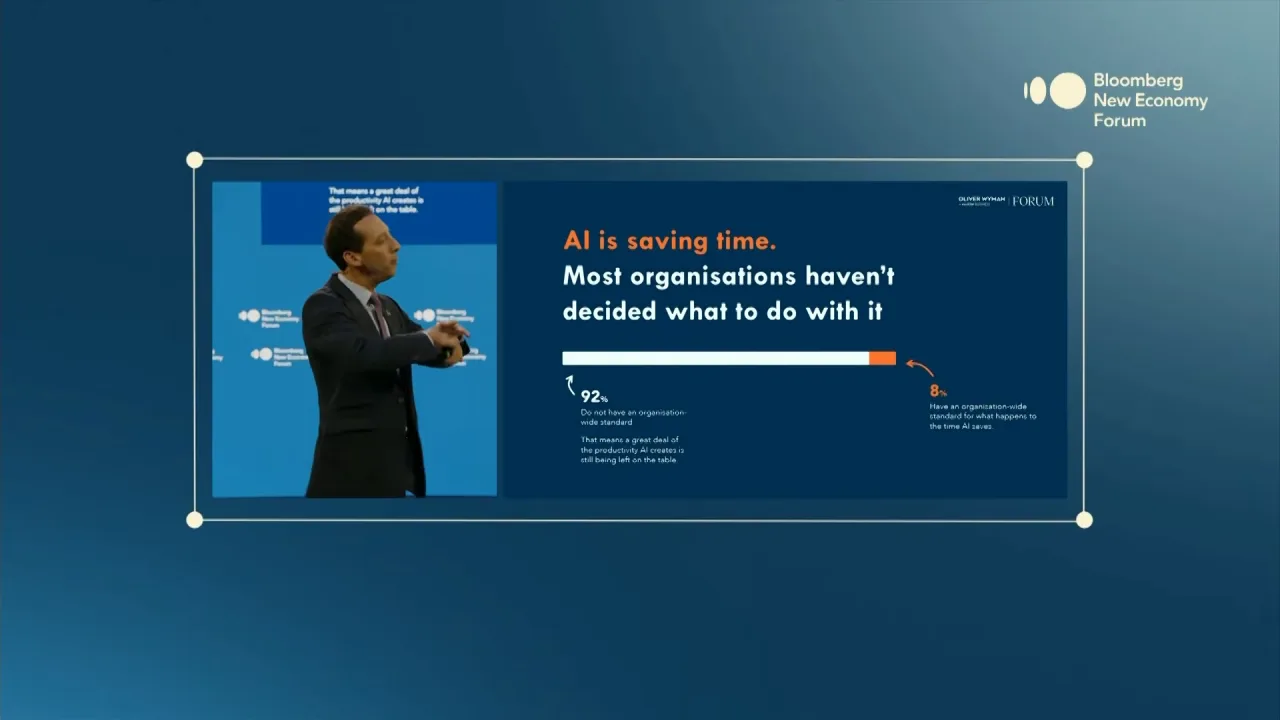
Still at 2:36 from Bloomberg New Economy, “We’re Watching the Wrong AI Race.” Oliver Wyman Forum slide.
AI is saving time. Most organisations haven’t decided what to do with it
| Share | Label on slide |
|---|---|
| 92% | Do not have an organisation-wide standard. That means a great deal of the productivity AI creates is still being left on the table. |
| 8% | Have an organisation-wide standard for what happens to the time AI saves. |
Still vs. transcript: Romeo says only the 8%. The slide adds the 92% complement and the conclusion that the productivity is “being left on the table.”
What was actually ingested
The full talk (6:40, length_seconds: 400), from a caption track labelled manual that wrote “AI” as “I” throughout; ten such cases and a few other errors were corrected at acquire (see the raw file’s notes:). The opening thanks and a stray closing word were dropped.
Stills. The Gemini scan found two slides but cut both frames after the director had switched to a full shot of the speaker, so neither showed its slide. Sampling ten frames across the two display windows found a picture-in-picture layout at 2:36 and 5:12 in which both slides are legible. The 2:36 frame was re-cut by hand and published; the 5:12 slide (68% would take a pay cut, source: Oliver Wyman Forum) repeats the narration word for word and was not published.
Linked entities and concepts
- micro-productivity-trap, agent-oversight-and-delegation, agentic-web, ai-sovereignty — updated in this ingest.
- dynamic-capabilities — the two cells tagged above.
Dangling (single-source mention, deferred): John Romeo, Oliver Wyman Forum, Bloomberg New Economy, Tim Berners-Lee, Yuval Noah Harari.
Scope and reliability
A short, scripted keynote by the head of a consultancy’s think tank. Both statistics are Oliver Wyman Forum’s own unpublished research as presented on stage, with no sample, method or date; treat them as indicative. The Berners-Lee and Harari attributions are relayed conversations, not citations. The durable content is the framing: three races rather than one, the four-part license-plate test for agents, and sovereignty defined as preserved choice.