Longo & Marchiaro (HubSpot UNBOUND 2026) — how AI is transforming search
▶ Watch on YouTube · HubSpot Live · 38:03
AI is changing how people discover, evaluate, and engage with businesses. Paul Longo, General Manager of AI in Ads at Microsoft Advertising, and Julian Marchiaro, Senior Director of Technology Strategy at Merkle, break down how marketers can reach high-value audiences and capture emerging demand, how the Microsoft Advertising and HubSpot integration connects ad data with CRM insights, and what shifting customer expectations mean for media operations and growth strategy.
TL;DR
A 38-minute session from HubSpot’s UNBOUND 2026 conference on the HubSpot Live channel, published 14 October 2026. Two parts: a ~20-minute keynote by Paul Longo, who runs AI advertising at Microsoft Advertising, and a ~17-minute fireside with Julian Marchiaro of the agency Merkle. It is a vendor keynote that ends in a product launch: the first integration between HubSpot and Microsoft Advertising. What it adds to the wiki:
- Three eras of the web, running at once. Longo’s frame, built on his own tennis shopping: buying grip tape he already knows (search — “help me find it”, the human web); choosing tennis shoes by asking Copilot (“help me choose”, the LLM web); having Copilot plan a French Open trip (“do it for me”, the agentic web). “We’re not moving from one to the other. All three are happening at the same time,” and brands must win in all three.
- Consumer-readiness numbers. From a Microsoft Advertising survey of 1,000 US adults (2026, “Race to Zero UI”): 67% like or love automation for simple tasks, 54% are comfortable with AI chatbots or conversational search, 60% are “ready for AI agents to replace traditional websites.” The same survey splits consumers 30 / 40 / 30 by how much support they want.
- Agent traffic. “AI traffic grows 8x faster than human traffic,” and “total agentic browser traffic” grew almost 8,000 year over year (Human Security’s 2026 benchmarks, per the slide). Customer journeys that include Copilot are 53% more likely to end in a purchase within 30 minutes.
- Measure AI visibility. Microsoft Clarity, a free site-analytics tool with about three million installs, now reports which AI conversations a brand appears in, its share of those conversations, and recommendations to improve; “you can’t optimize what you can’t measure.”
- Marchiaro: use the freed time on purpose. “Organizations, particularly the large ones, are good at carrying inefficiencies. The automation creates slack… How is that slack being used?” Map how you work before automating, define an innovation ambition, give someone the full-time job, and stop waiting for the best model.
Key claims
The human web is still most of the money
Longo does not say search is dying. Bing has just passed one billion monthly active users, “the majority of clicks are still coming through the human web” and so is most advertising revenue. What changes is that search is “becoming more conversational,” so fixed keyword lists “can’t cut it anymore.” Microsoft’s answers are Performance Max (one campaign across Bing, Edge, Outlook, MSN, Xbox and LinkedIn surfaces) and AI Max, which matches ads to conversational queries; the slide claims AI Max “delivers 8% increase in conversions on Search.” Longo adds a targeting argument unrelated to AI: 49% of US personal spending now comes from the top 10% of earners, up from 43% in 2020, and Microsoft’s audience skews towards them.
The LLM and agentic web: be in the conversation
“Consumers are having conversations about brand decisioning in LLMs. Those LLMs are going to your websites to pull your website content into that conversation.” Longo’s test for the audience: “What’s the most valuable conversation that you want to make sure that you’re showing up in? And how confident are you that your brand will show up?” The slide states it more sharply: “It reasons. It decides. It buys. But does it pick your brand?”
His prescriptions, paid and organic:
- Paid — the same Performance Max and AI Max campaigns, which can appear on new AI surfaces and against conversational queries.
- Measurement — Microsoft Clarity’s AI-visibility view: conversations a brand appears in, share of conversation, and improvement recommendations. Free.
- Feeds — “don’t sleep on your feeds”: product feeds in Microsoft Merchant Center are “a core component of ensuring you show up in LLMs,” with UCP enabled so products are represented correctly in LLM environments. (UCP is not expanded on stage.)
- On-site agents — a “brand agent” powered by Clarity that “enables agentic commerce on your site,” left for the booth.
The CRM closes the loop
The launch: a HubSpot–Microsoft Advertising integration that turns HubSpot contacts into audiences across the Microsoft network, retargets them, and reports “every contact, deal, and dollar right in HubSpot.” Longo says it was the integration HubSpot customers asked for most.
Marchiaro: innovation by design, context over data, slack used deliberately
The fireside moves from products to operating questions:
- Innovating by accident. “In many organizations we’re still innovating by accident, not by design.” His question to the audience: is your team structured for innovation, or is it “happening in pockets”?
- Modern CRM is context, not data. “Data in itself is not a moat anymore. It’s not a differentiator. It’s the context that you can bring with it in service of decisioning,” and the next frontier is making that decisioning real time: a nurture that reacts to the webinar a lead just attended or the sales rep they ghosted, not only to their pipeline stage. He calls the shift one from customer centricity to “human centricity.”
- Media. Activating first-party data in media (suppressions, look-alikes, precision targeting) is “a proven path”; AI recommendations on moving budget between campaigns and placements are early.
- Slack. AI is freeing time for “higher level strategic work,” such as weighing the options an AI recommends against one’s own understanding of the business, or managing publisher relationships. But “organizations, particularly the large ones, are good at carrying inefficiencies. The automation creates slack… How is that slack being used? How are the efficiencies transforming into growth and results for the business? And the question is, are you being intentional?”
- What to do first. Map how you work today, or “how can you go identify the next bottleneck to solve for”; and “it’s not just about … using AI as glue to stitch together broken processes, but it’s rethinking your process.” Define the innovation ambition. Free up a team, because such initiatives are often done “on the side of their desk” when “that’s a full-time job.”
- Model parity. Citing a recent Stanford report, he says models are reaching parity on productivity, so the choice matters little early on: “just go deep in the stack that you have available. Use the integrations you already have access to.”
Dynamic-capabilities reading
contextual/external-triggers— the whole keynote is about a shift that customers make first: shoppers moving from search to assistants and agents, which brands must follow whether or not they planned to.digital-sensing/digital-scouting— Clarity’s AI-visibility view (which conversations, share of conversation, citation rate, share of authority by domain) is a scouting instrument for a channel whose demand data the brand cannot otherwise see.digital-transforming/redesigning-internal-structures— Marchiaro’s fireside: structure the team for innovation rather than pockets, map the current process before automating it, and make the innovation work someone’s full-time job rather than a side task.
How it connects
- agentic-web — the three-eras frame as a vendor’s map of the same shift; agent-traffic figures from a third measurer (Human Security) alongside Cloudflare’s; agents that decide and buy, as in Collison.
- answer-engine-optimization — Clarity’s citation rate and share of authority by domain, product feeds as an AEO input, and paid placement against conversational queries. Same conference as Amiel & Sanders and Bodnar & Flanagan.
- micro-productivity-trap — Marchiaro’s “automation creates slack” and his warning against AI “as glue to stitch together broken processes.”
- enterprise-ai-adoption — innovation by accident versus by design, and model parity as a reason to stop shopping for tools.
Visual canon
Six of 24 machine-found stills were published; the rest are product and audience slides for Microsoft Advertising.
1 · Customers are quickly becoming more comfortable with AI-powered experiences
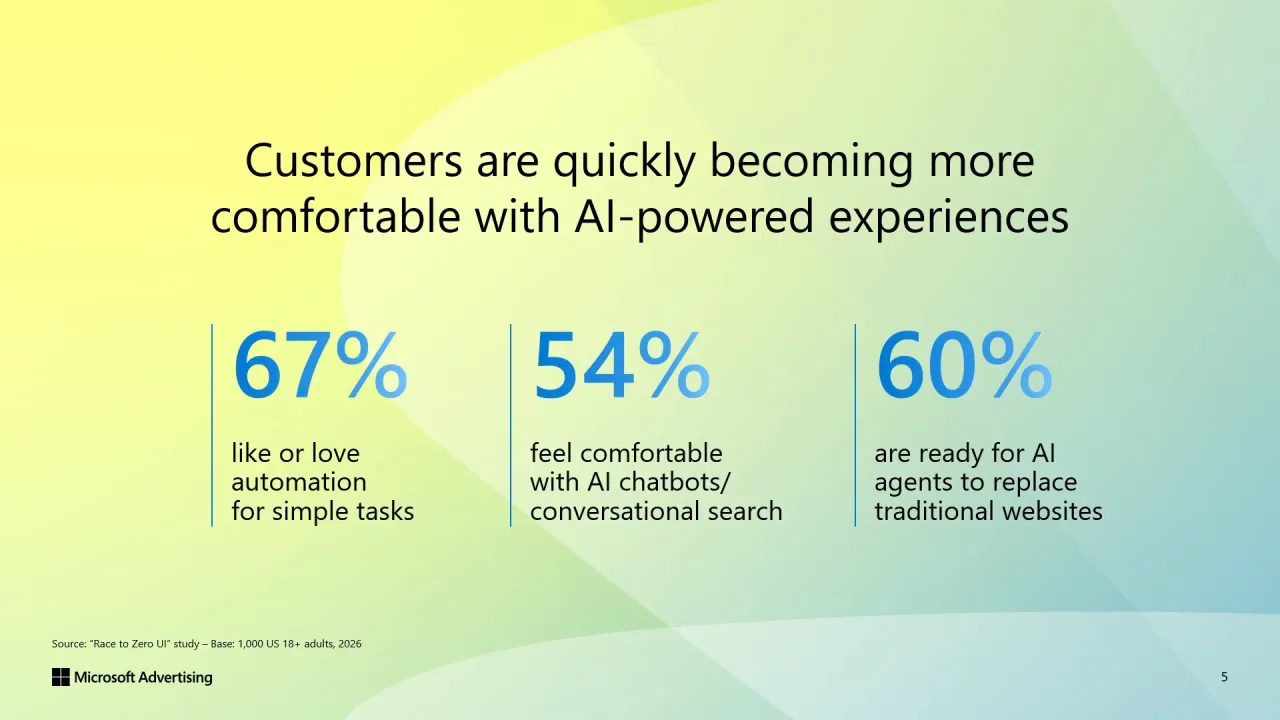
Still at 4:42 from HubSpot Live, “How AI Is Transforming Search: New Rules of Demand Capture.”
| Share | Statement |
|---|---|
| 67% | like or love automation for simple tasks |
| 54% | feel comfortable with AI chatbots/conversational search |
| 60% | are ready for AI agents to replace traditional websites |
Source: “Race to Zero UI” study – Base: 1,000 US 18+ adults, 2026.
Still vs. transcript: Longo cites only the 54% and 60% and attributes them to “our consumer research at Microsoft.” The slide adds the 67% figure, the study name and its base.
2 · However, consumers still need different levels of support from brands
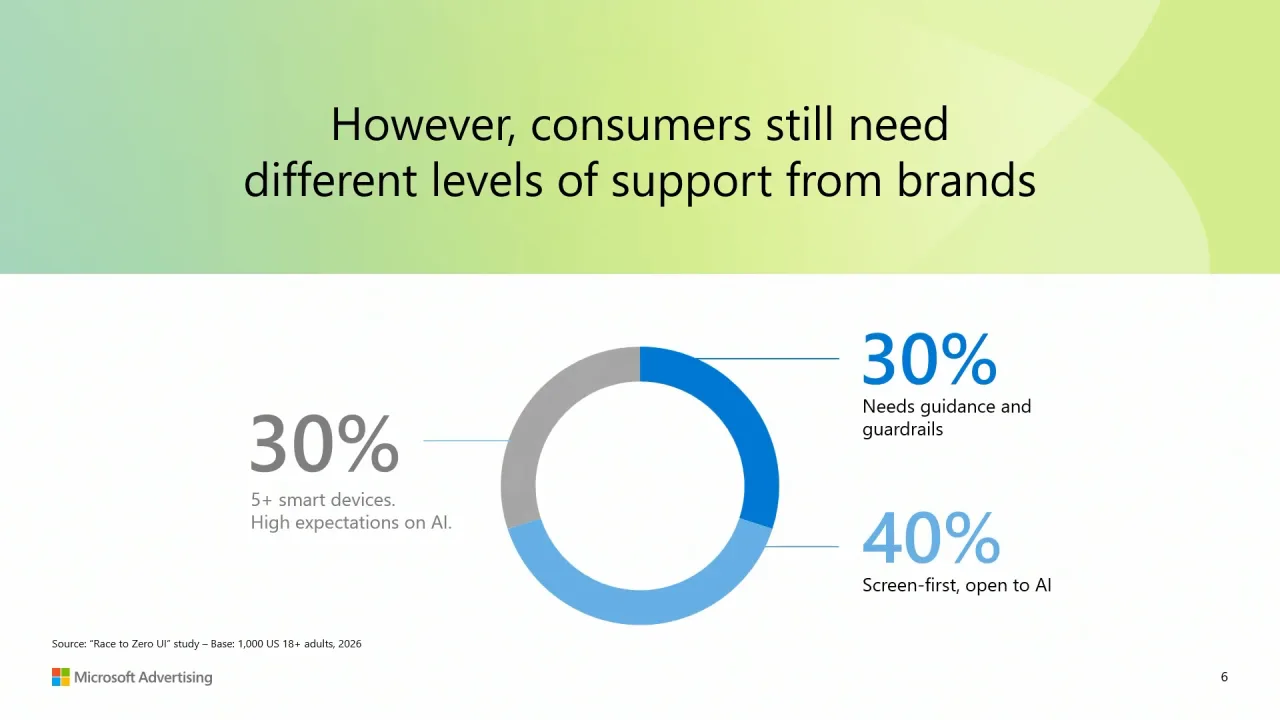
Still at 5:21.
- 30% — Needs guidance and guardrails
- 40% — Screen-first, open to AI
- 30% — 5+ smart devices. High expectations on AI.
Source: “Race to Zero UI” study – Base: 1,000 US 18+ adults, 2026.
Still vs. transcript: the narration describes three readiness levels (“handheld”, “do everything for me”, “a big group in the middle”) without sizes. The slide gives the 30 / 40 / 30 split.
3 · To win, brands need to optimize across all three eras of the web at once
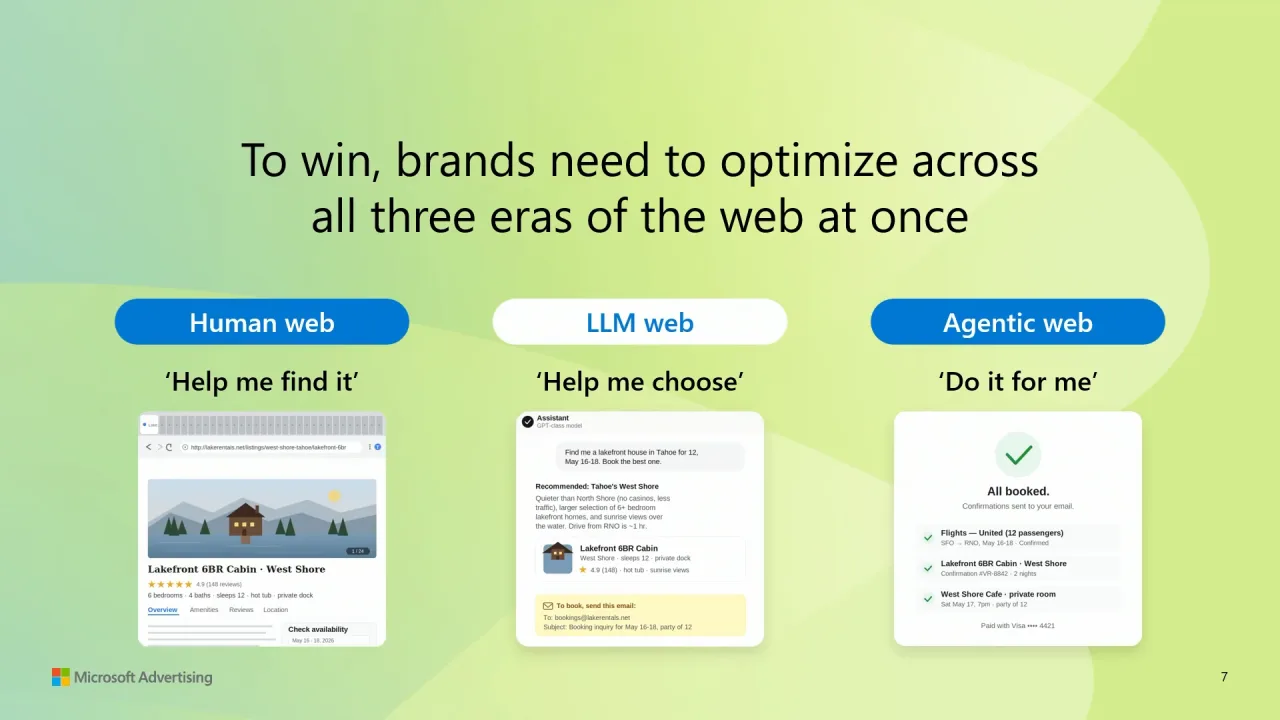
Still at 6:08.
| Human web | LLM web | Agentic web |
|---|---|---|
| ’Help me find it' | 'Help me choose' | 'Do it for me’ |
| A rental listing page (Lakefront 6BR Cabin, West Shore; 4.9, 148 reviews; check availability) | An assistant recommends Tahoe’s West Shore and the cabin for a party of 12, then says “To book, send this email" | "All booked.” Flights (United, 12 passengers, SFO → RNO), cabin and a restaurant table confirmed; “Paid with Visa •••• 4421” |
Still vs. transcript: the narration uses tennis examples. The slide shows one task, a group trip, at all three eras, and marks the boundary between the second and third exactly: in the LLM web the assistant still hands the booking back to the person; in the agentic web it books and pays.
4 · AI and agentic traffic growth
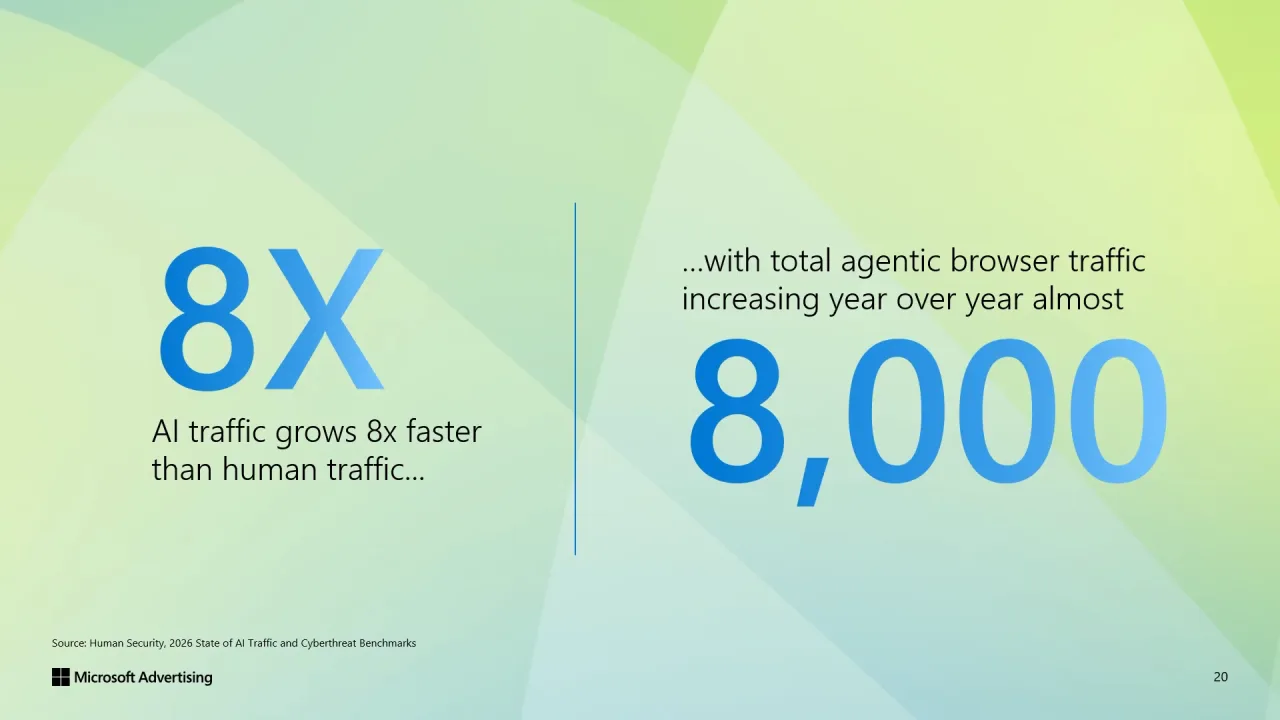
Still at 13:45.
8X — AI traffic grows 8x faster than human traffic… …with total agentic browser traffic increasing year over year almost 8,000
Source: Human Security, 2026 State of AI Traffic and Cyberthreat Benchmarks.
Still vs. transcript: the narration gives no source and says “agentic traffic is growing 8,000%.” The slide names Human Security (a bot-detection vendor), narrows the claim to agentic browser traffic, and prints the number without a unit.
5 · AI experiences also accelerate intent and improve conversion rates
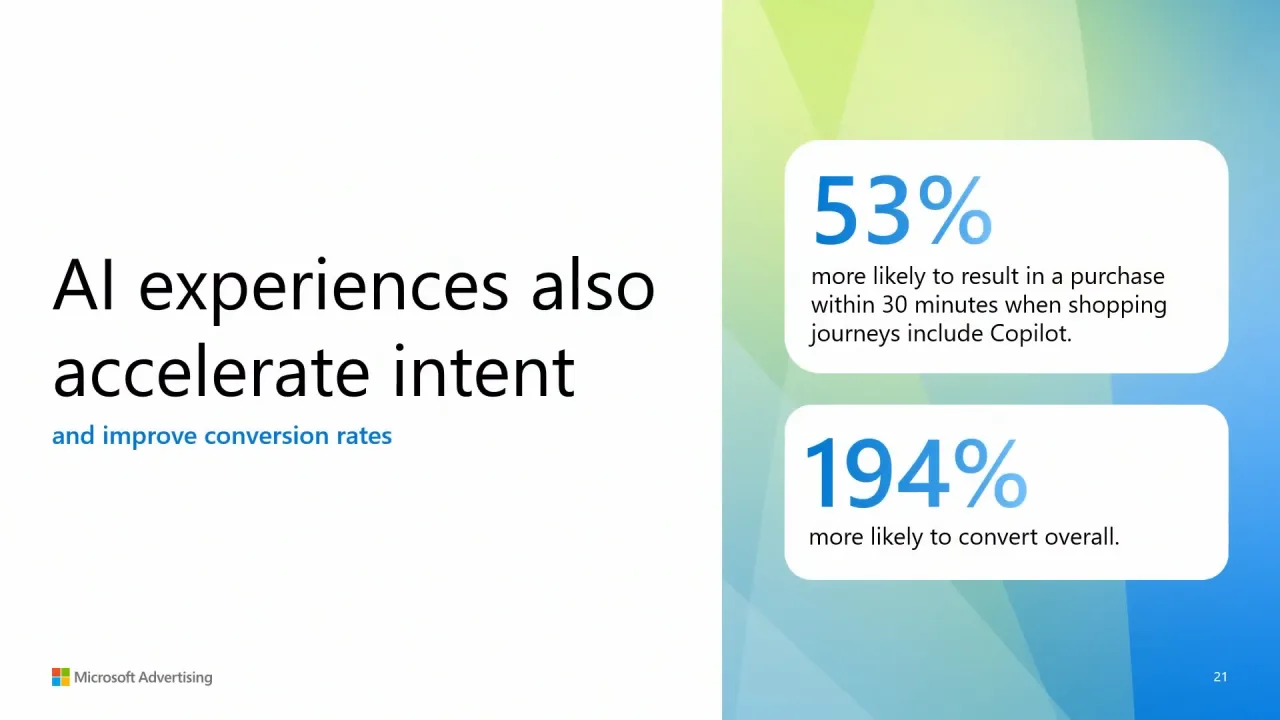
Still at 14:24.
- 53% more likely to result in a purchase within 30 minutes when shopping journeys include Copilot.
- 194% more likely to convert overall.
Still vs. transcript: Longo says only the 53% figure (for journeys with “Copilot and Bing search”). The 194% figure is on the slide only. Neither has a source or method on the slide.
6 · Understand how AI represents and cites you with Microsoft Clarity
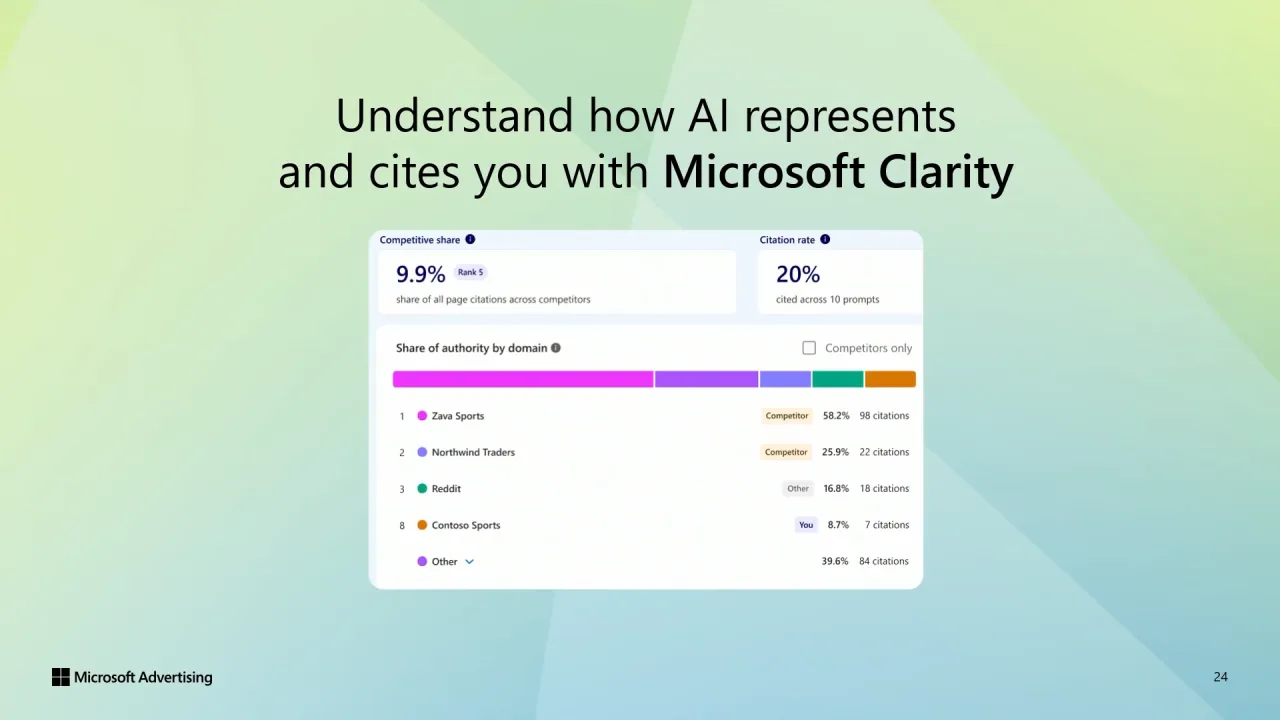
Still at 15:57. A product mock-up with Microsoft’s fictional demo brands.
- Competitive share — 9.9%, Rank 5: share of all page citations across competitors.
- Citation rate — 20%: cited across 10 prompts.
- Share of authority by domain:
| Rank | Domain | Type | Share | Citations |
|---|---|---|---|---|
| 1 | Zava Sports | Competitor | 58.2% | 98 |
| 2 | Northwind Traders | Competitor | 25.9% | 22 |
| 3 | Other | 16.8% | 18 | |
| 8 | Contoso Sports | You | 8.7% | 7 |
| Other | 39.6% | 84 |
Still vs. transcript: the narration names three things Clarity shows (conversations, share of conversation, recommendations). The slide shows the actual metrics: a citation rate over a fixed prompt set, and a share of citations by domain that puts competitors and third-party sites such as Reddit in the same ranking as the brand. The demo numbers do not add up (the shares sum above 100%, and 9.9% and 8.7% are both given for “you”), so read it for the metric definitions only.
What was actually ingested
The full session (38:03, length_seconds: 2283), from auto-generated captions with no manual track. Product and people names were corrected at acquire (AI Max, Copilot, Merkle, Julian Marchiaro and others; see the raw file’s notes:); other ASR noise is left as spoken. A sizzle video for the integration announcement at ~18:00 has no captions. Stills: a full Gemini scan (214,496 tokens) found 24 slides, all in Longo’s keynote; six were verified against their pixels and published.
Linked entities and concepts
- HubSpot — conference host; the HubSpot–Microsoft Advertising integration launched in this session. Updated in this ingest.
- Microsoft — Longo’s employer; Bing, Copilot, Clarity, Performance Max and AI Max. Updated in this ingest.
- agentic-web, answer-engine-optimization, micro-productivity-trap, enterprise-ai-adoption — updated in this ingest.
- dynamic-capabilities — the three cells tagged above.
Dangling (single-source mention, deferred): Paul Longo, Julian Marchiaro, Merkle, Microsoft Advertising, Human Security, Nava Hopkins.
Scope and reliability
A vendor selling to a vendor’s customers. Microsoft Advertising presents its own products at HubSpot’s conference, in a session that launches a joint integration; nothing in it is neutral. Most statistics are Microsoft first-party research (the Race to Zero UI survey, the Copilot conversion figures, the AI Max uplift) with no method on the slides; the agent-traffic figures come from Human Security, which sells bot detection. The Clarity dashboard is a mock-up. What is durable is the three-eras frame (one task shown at three levels of delegation), the metric definitions for AI visibility, and Marchiaro’s operating advice, which is independent of the products.