Wang (Google Cloud Tech) — agent memory: facts in SQL, understanding in a vector store
▶ Watch on YouTube · Google Cloud Tech · 12:26
In this episode, you’ll learn the critical difference between Structured Facts and Semantic Understanding, why they should never live in the same database, what to do with raw audio/video perception, and how to read and write memory asynchronously without blocking latency-sensitive voice streams.
Watch along and learn: Short-Term (RAM) vs. Long-Term Agent Memory · Facts (Exact Lookup) vs. Understanding (Semantic Recall) · Why dumping exact facts into a vector store breaks your agent · Where to store Structured Memory (PostgreSQL, MySQL, Google Cloud SQL) vs. Semantic Memory (pgvector, AlloyDB, Vertex AI Agent Engine Memory Bank) · How to handle raw multimodal perception (camera frames & audio waveforms) · The Two-Track Read/Write Loop: Synchronous tool calls for facts vs. asynchronous off-the-hot-path extraction for understanding
TL;DR
A 12-minute explainer on the Google channel Google Cloud Tech, published 28 October 2026, in its series The Omni App, presented by Annie Wang. The demo is a personal styling agent with a voice interface that remembers a user’s wishlist and taste across sessions. Four rules:
- Session memory is RAM. “The real design question is not can we save everything. The real question is, what is worth carrying into the next session.”
- Two kinds of long-term memory, two stores. Facts (“you bought the blue jacket”) are exact, have IDs and dates, and belong in a structured database such as Cloud SQL or Postgres. Understanding (“you prefer simple over flashy”) is a pattern and belongs in a store searched by meaning: pgvector, AlloyDB, or a managed service such as Vertex AI Agent Engine’s Memory Bank, which also extracts and updates memories from sessions.
- Raw perception is not memory. Camera frames and audio waveforms may be kept for replay, audit or training, but agent memory keeps the meaning extracted from them.
- Two tracks for reading and writing. At session start, load both. Write facts at once through a tool call; extract understanding asynchronously, “off the live path,” because extraction needs a model and a voice agent cannot wait for it.
Key claims
The common mistake
“They hear semantic memory and they put everything into the vector store.” Similarity is useful when the question is fuzzy and “dangerous when the answer must be exact.” Asked “what did I buy,” the agent should query the database, not guess from a similar memory.
Judgment before writing to memory
Understanding is not updated from one sentence: “If I say maybe I like yellow today, that does not mean yellow is … my whole style.” A memory service reviews the conversation and keeps only strong signals, such as a reason the user gives or a pattern repeated across sessions. Extraction can run per turn or at intervals, not only at session end; per-turn extraction gives cleaner memories and keeps what a user said before dropping off.
Not tied to one product
“The lesson is not, you must use memory bank. The lesson is understanding goes in a system that can search by meaning.” With a plain vector store you write the extraction logic yourself; with Memory Bank it is managed.
Visual canon
1 · The rule: exact or fuzzy?
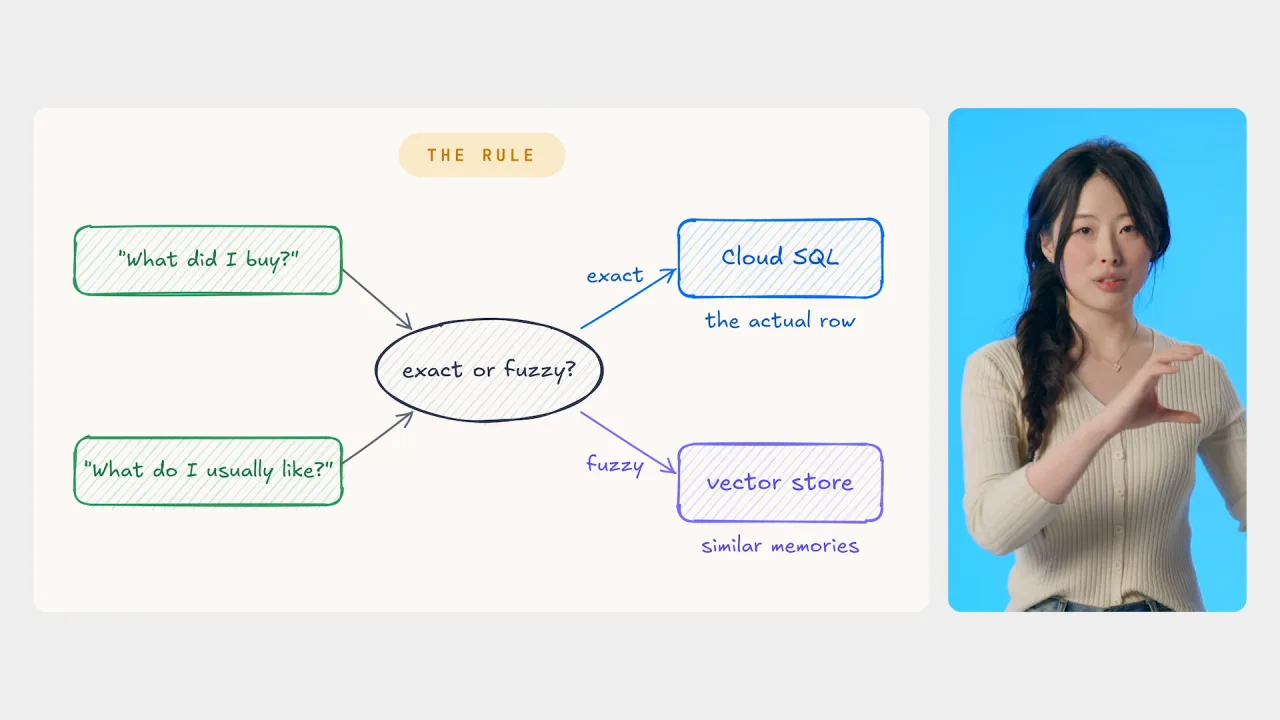
Still at 5:17 from Google Cloud Tech, “AI Agent Memory Architecture: Structured SQL, Semantic Vector Search & Memory Bank”.
THE RULE. “What did I buy?” and “What do I usually like?” both enter exact or fuzzy? — exact → Cloud SQL, the actual row; fuzzy → vector store, similar memories.
Still vs. transcript: the narration gives the two example questions separately; the diagram makes the routing decision the single test that sends each question to one store.
2 · Session start reads both stores
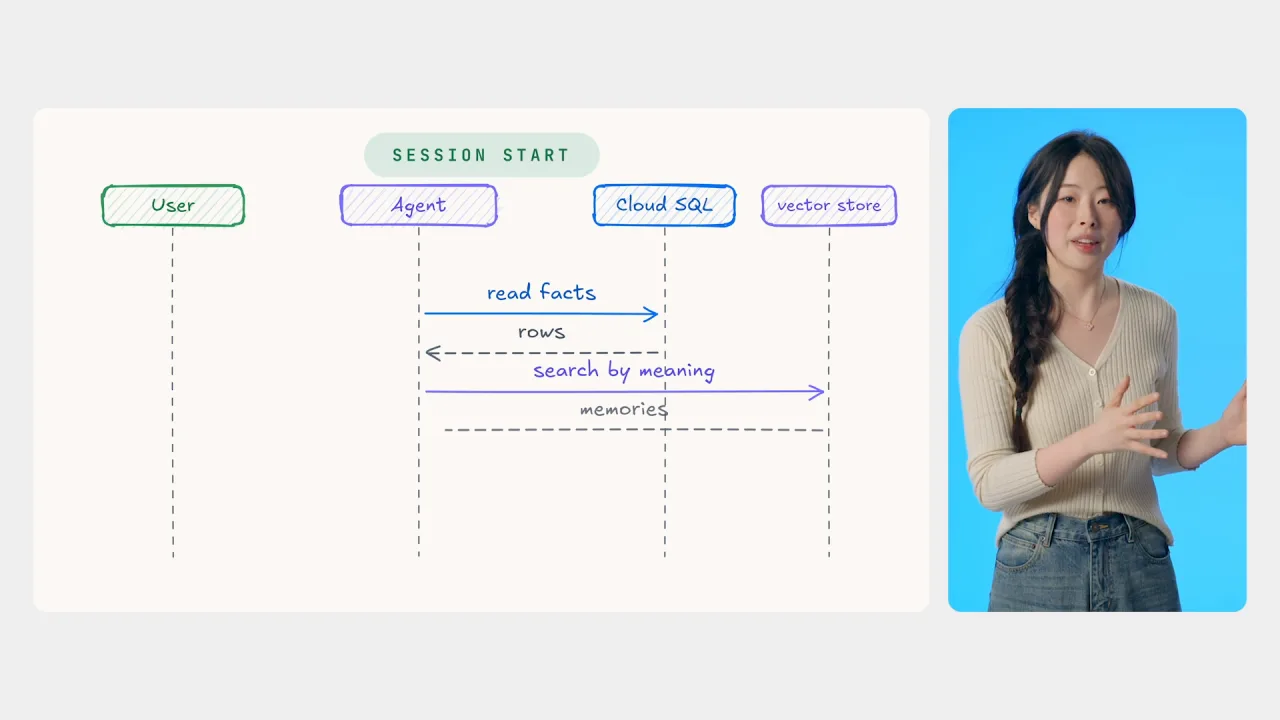
Still at 6:53 from Google Cloud Tech, “AI Agent Memory Architecture: Structured SQL, Semantic Vector Search & Memory Bank”.
SESSION START. Lanes: User, Agent, Cloud SQL, vector store. Agent → Cloud SQL: read facts, ← rows. Agent → vector store: search by meaning, ← memories. The User lane has no traffic yet.
Still vs. transcript: the sequence diagram shows that both reads happen before the user has said anything.
3 · Judgment: only strong signals
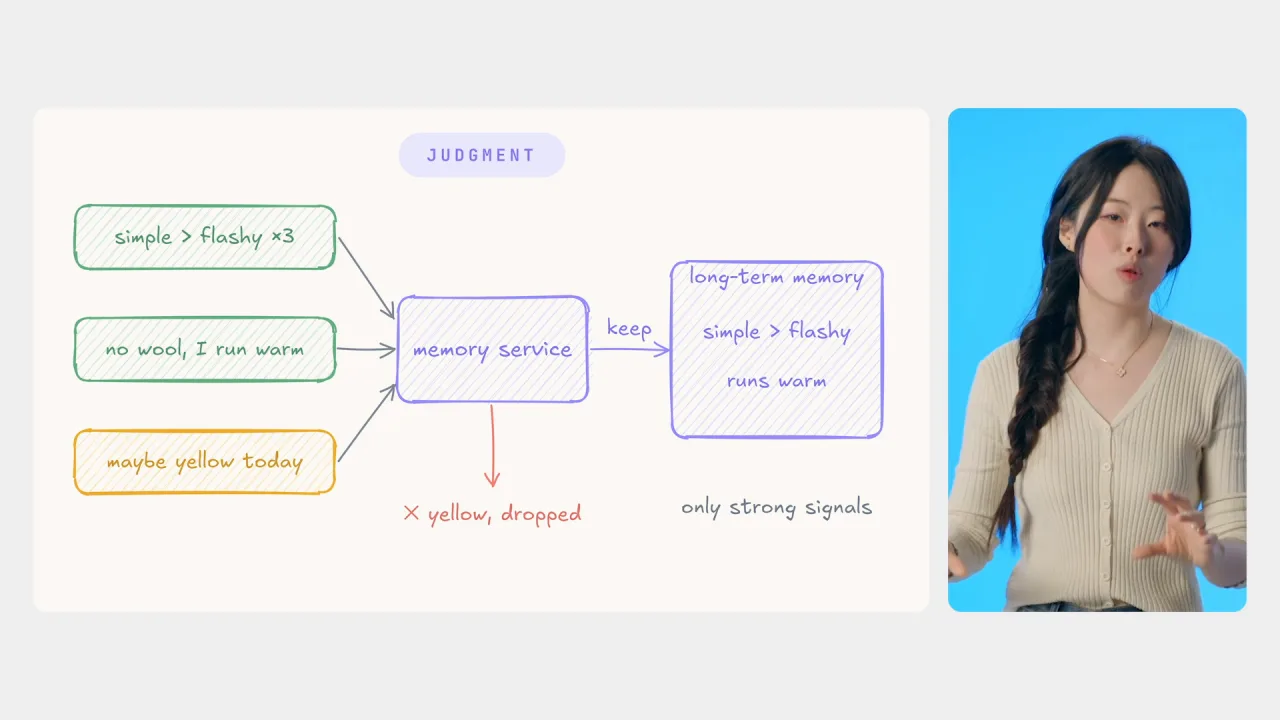
Still at 8:41 from Google Cloud Tech, “AI Agent Memory Architecture: Structured SQL, Semantic Vector Search & Memory Bank”.
JUDGMENT. Three signals enter a memory service: simple > flashy ×3, no wool, I run warm, maybe yellow today. It keeps simple > flashy and runs warm in long-term memory; ✗ yellow, dropped. Caption: only strong signals.
Still vs. transcript: the slide shows the repetition count (×3) as what makes a preference strong, and the explicit drop of the one-off remark.
4 · Keep extraction off the live path
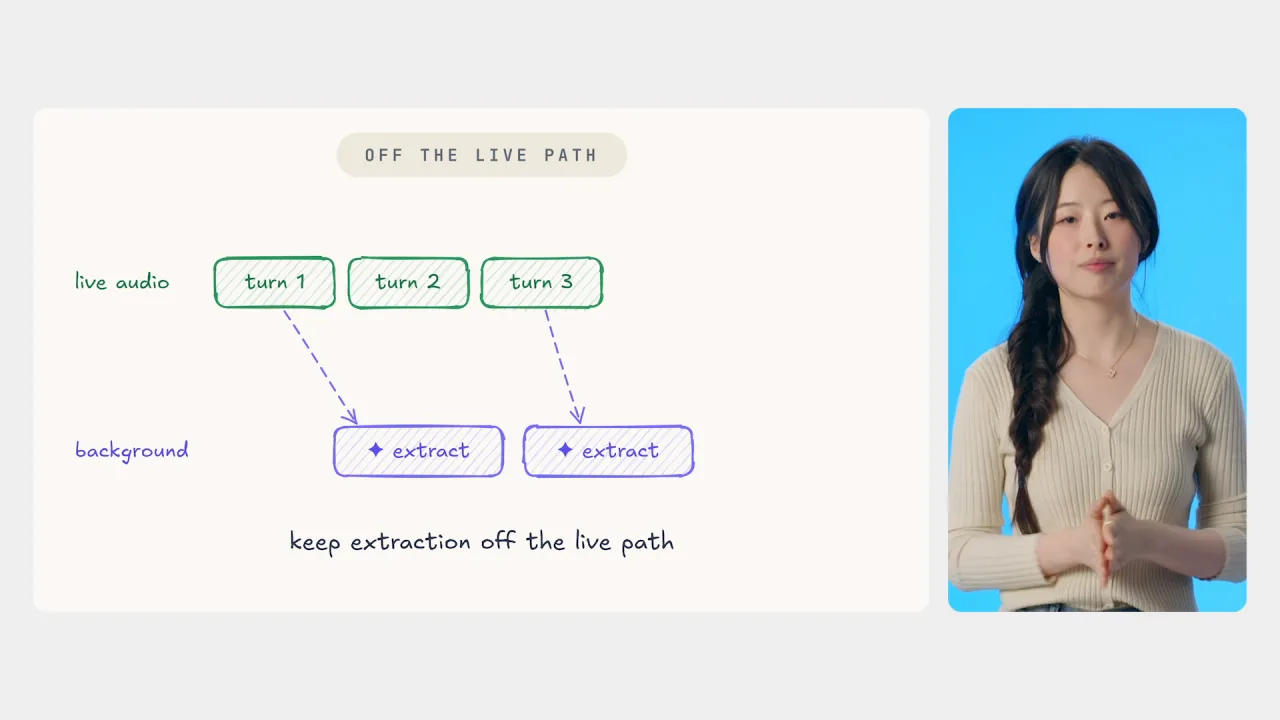
Still at 9:53 from Google Cloud Tech, “AI Agent Memory Architecture: Structured SQL, Semantic Vector Search & Memory Bank”.
OFF THE LIVE PATH. live audio: turn 1, turn 2, turn 3. background: ✦ extract after turn 1 and after turn 3. Caption: keep extraction off the live path.
Still vs. transcript: the timeline shows extraction triggered by turns but running beneath them, not after every turn, and never in the audio lane.
How it connects
- agent-harness — memory as a harness component, with a design split by what the memory is for.
- ai-agents — long-term memory for multimodal, voice-first agents.
- knowledge-graphs — a neighbouring answer to the same question (structure for exact relations, retrieval for meaning).
Related in this wiki
- Bratanic on agent memory with hooks — hooks log events deterministically with no model call, and a separate dream pass distils them into memory. Wang’s design has the same split: cheap synchronous writes, model-based extraction kept off the latency-sensitive path.
- Holmes (Warp) — the other way to learn from past sessions in this batch: scoring runs and changing skills, not storing what the user is like.
- Annie Wang’s earlier explainers on the same channel: graph engineering and four ways loop engineering fails.
What was actually ingested
The full video (12:26, length_seconds: 746), 77 lines, through the yt-dlp fallback from a track listed as human-written. Its quality is closer to ASR (“Facts instruction” for facts in structured, “like classical” for like Cloud SQL, “Anaia” for Annie); quotes here are corrected against the slides and the description. Stills were picked by hand: no Gemini key on this machine. 62 frames sampled every 12 seconds, 6 candidates read at 1080p, 4 published; two were caught mid-animation and dropped. See the manifest. The demo’s code (linked as fashion-mind) was not read.
Linked entities and concepts
- Google — publisher (Google Cloud Tech channel). Updated in this ingest.
- Annie Wang — presenter. Updated in this ingest.
- agent-harness, ai-agents — updated in this ingest.
Dangling (single-source mention, deferred): Memory Bank (Vertex AI Agent Engine), Cloud SQL, AlloyDB, Gemini Live API, The Omni App.
No dynamic_capabilities:: an architecture explainer, outside the Warner & Wäger lens.
Scope and reliability
A vendor explainer that names its own products, though it says the pattern works without them. The design is reasoned, not measured: nothing here compares memory quality or latency between the single-store and two-store designs. The demo is a consumer styling agent; the advice is aimed at voice agents, where latency rules out synchronous extraction.