Lloyd (Warp) — what it takes to build a software factory
▶ Watch on YouTube · Warp · 25:51
Software factories are the next step after interactive coding agents. Warp founder and CEO Zach Lloyd covers what a cloud software factory is, why it should be treated as open infrastructure defined in code, and how “factory engineering” helps your agents improve over time.
TL;DR
A 26-minute recorded talk with a product demo on the Warp channel, published 19 October 2026. Zach Lloyd, Warp’s founder and CEO and formerly a principal engineer who ran engineering for Google Docs, describes the software factory as the next stage after developers prompting coding agents on their laptops, and demonstrates Warp’s product for it, Warp Factories. Five claims:
- Local interactive agents have three problems: they are “bottlenecked by people,” their costs cannot be optimised collectively, and “there’s no central layer for governing them”; a compromise acts “as the logged-in user.” Sandbox them in the cloud.
- A software factory is a measurable loop. Ideas come in; agents triage, write a spec, implement, review, verify with computer use, ship and monitor; people are looped in at review points. It runs in the cloud, because “you can’t have automations running off your laptops.”
- Treat it as open infrastructure defined in code. The factory’s agents, MCPs, repositories and skills are declared and versioned, so it can be tested and rolled back; it should accept “any model, any harness,” run on your own compute, and keep the data, because “that data is what you’re going to use to improve your agents.”
- Factory engineering is a second kind of engineering beside product engineering: tune the factory using cost and flow metrics, LLM-judge scoring of every run, a self-improvement loop in which agents propose changes to the factory’s own definition, and internal benchmarks that replay real tasks against different models.
- Warp’s result: cost per pull request from about $55 to around $15 “in the last six weeks,” PR throughput up about 40%, with a lower revert rate: “So this isn’t just putting out slop.”
Key claims
From autocomplete to factories
Lloyd’s arc: Cursor-style autocomplete a couple of years ago; then, “about a year ago,” every developer running Claude Code or Codex locally and prompting features into pull requests; next, “much more automated development.” Interactive agents leave productivity bounded by people, scatter cost, and lack governance. The factory he proposes is not one fixed process: “This loop is going to look different in its details at every company, on every team.”
Open, in code, and sovereign
He holds the factory should be infrastructure “as flexible as GCP or AWS,” composable and pluggable, working with the tools a company already has (work enters through Slack, Teams, Linear, Jira, GitHub or a local agent). Defining it in code “creates opportunities: how do you test different versions of a factory? How do you let agents self-improve a factory?” He uses the term AI sovereignty for keeping the factory’s data, compute, inference gateway and model choice under the company’s own control: “open is going to win here, as opposed to a walled garden, single-vendor solution.”
Factory engineering
The product engineer works through the factory; the factory engineer makes it “more efficient… a lot of performance tuning: figuring out what skills and MCPs, what model mix, and what workflow are right.” Three tools:
- Metrics: human interactions per PR, degree of automation, time to ship, and cost per PR by source, user, agent and model, “and having a plan in place to drive it down.”
- Scoring: LLM-as-judge over stored agent runs, sampled because it is expensive. Warp’s example is redundant tests, a failure mode where agents “waste a bunch of money, time, and context writing unnecessary tests.”
- Self-improvement: agents read the failed scores, find repeated problems (“a problem with our triage agent. We saw this 54 times”) and open a pull request against the factory definition so it does not recur.
Your own benchmark
Recorded tasks can be added to a benchmark suite and replayed against different models and harnesses, producing “a correctness-versus-cost trade-off curve” for the company’s own work rather than relying on SWE-bench or Terminal-Bench. In his run, GPT-5.6 Sol cost $6.23 on average for 95% correct; GLM-5.3 Flash cost about a third and was “just a little less correct”; “we would probably choose GLM-5.3 Flash for this, honestly,” and the result feeds a model-routing rule. Lloyd on the public conversation about models: “It’s hard to tell who has a conflict of interest.”
Visual canon
1 · More AI usage is not more business value
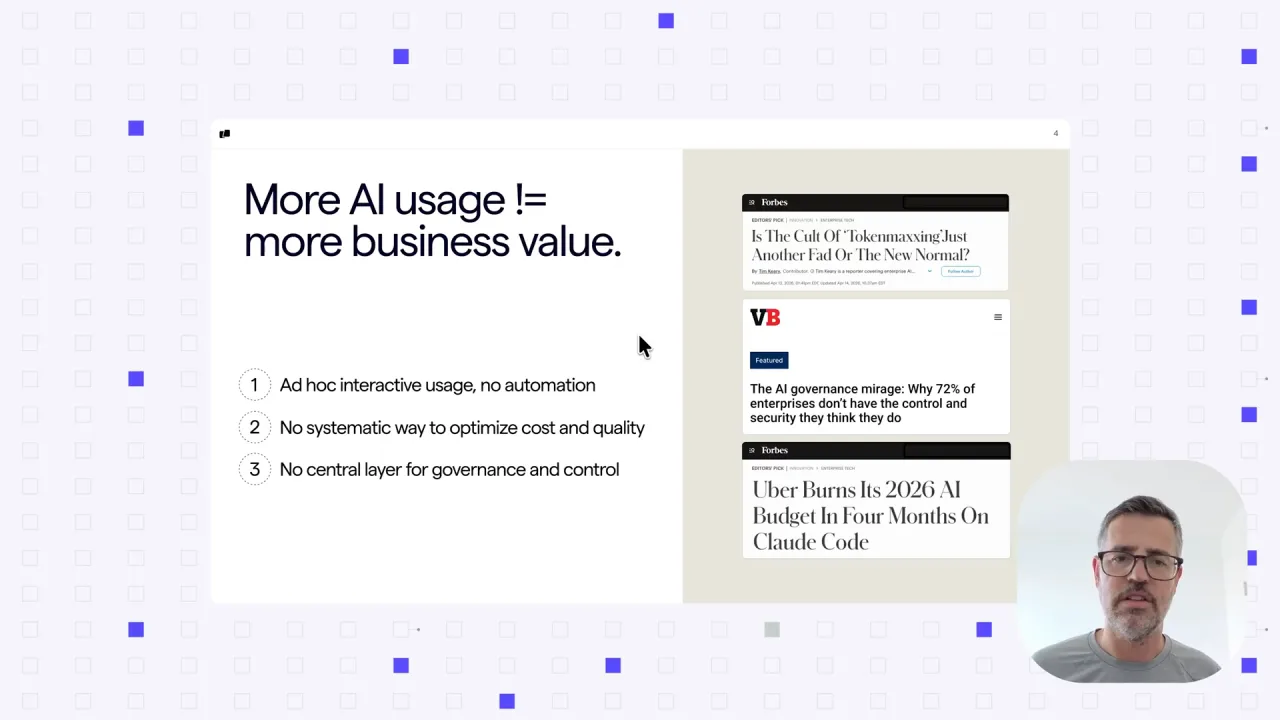
Still at 3:12 from Warp, “What it takes to build a software factory”.
More AI usage != more business value.
- Ad hoc interactive usage, no automation
- No systematic way to optimize cost and quality
- No central layer for governance and control
Press clippings beside the list: Forbes, “Is The Cult Of ‘Tokenmaxxing’ Just Another Fad Or The New Normal?” (13 April 2026); VentureBeat, “The AI governance mirage: Why 72% of enterprises don’t have the control and security they think they do”; Forbes, “Uber Burns Its 2026 AI Budget In Four Months On Claude Code.”
Still vs. transcript: the narration names the three problems; the slide adds the press evidence Lloyd uses to motivate them, including the Uber budget headline.
2 · The cloud software factory loop
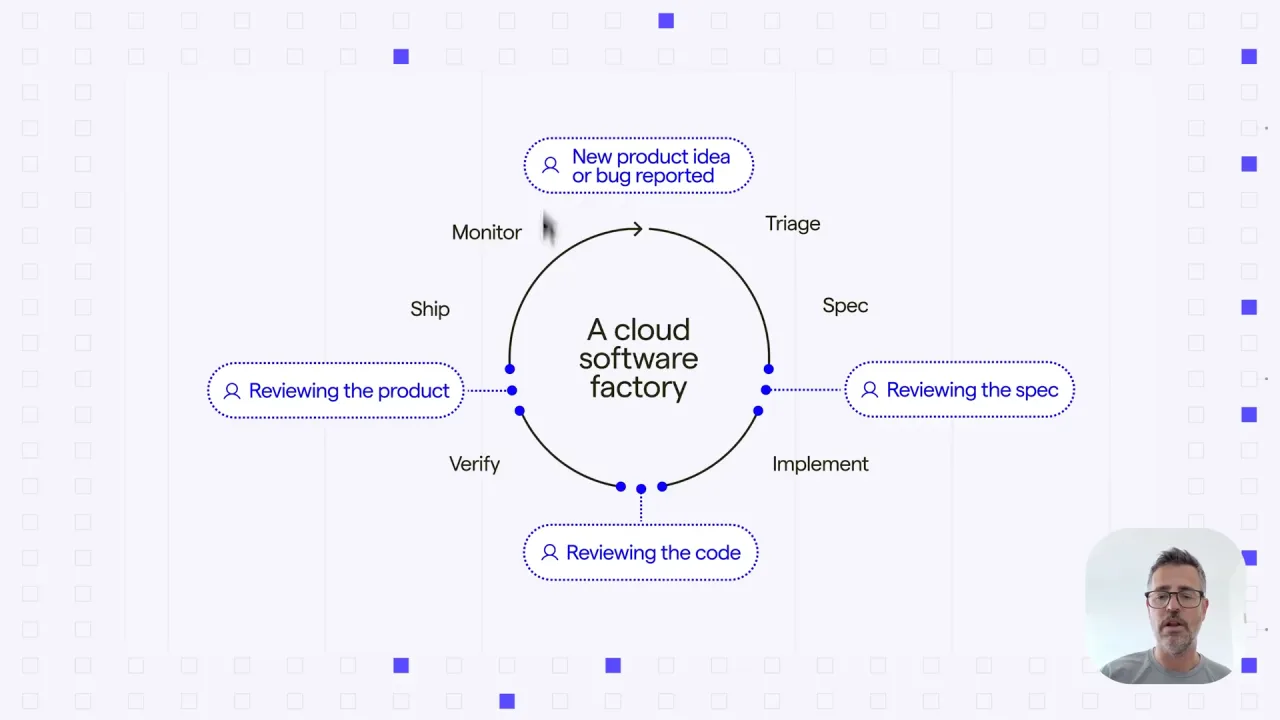
Still at 5:06 from Warp, “What it takes to build a software factory”.
A loop around A cloud software factory: Triage → Spec → Implement → Verify → Ship → Monitor, entered by “New product idea or bug reported.” Three human touch points sit on the loop: Reviewing the spec (after Spec), Reviewing the code (between Implement and Verify), Reviewing the product (between Verify and Ship).
Still vs. transcript: the narration lists the steps; the diagram places the three human review points on the loop.
3 · Cost per pull request, by component
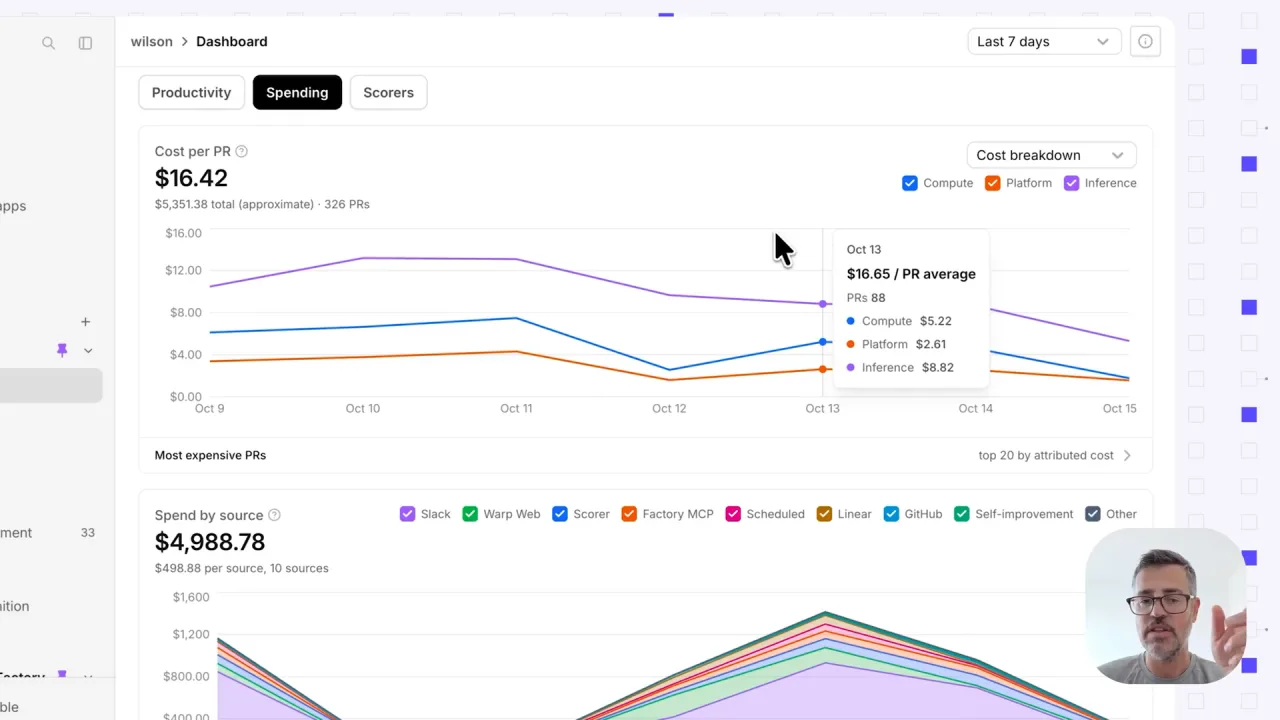
Still at 14:05 from Warp, “What it takes to build a software factory”.
The factory dashboard’s Spending tab, last 7 days: cost per PR $16.42 ($5,351.38 total, approximate, 326 PRs). Hover on 13 October: $16.65 per PR average over 88 PRs, split compute $5.22, platform $2.61, inference $8.82. Below: Spend by source $4,988.78 ($498.88 per source, 10 sources: Slack, Warp Web, Scorer, Factory MCP, Scheduled, Linear, GitHub, Self-improvement, Other).
Still vs. transcript: the narration says to know your cost per PR; the dashboard shows a figure consistent with his ~$15 claim and that inference is about half of it, with compute and platform the rest. The workspace is labelled wilson; whether it is Warp’s own production factory is not said.
4 · Benchmark: correctness against average cost
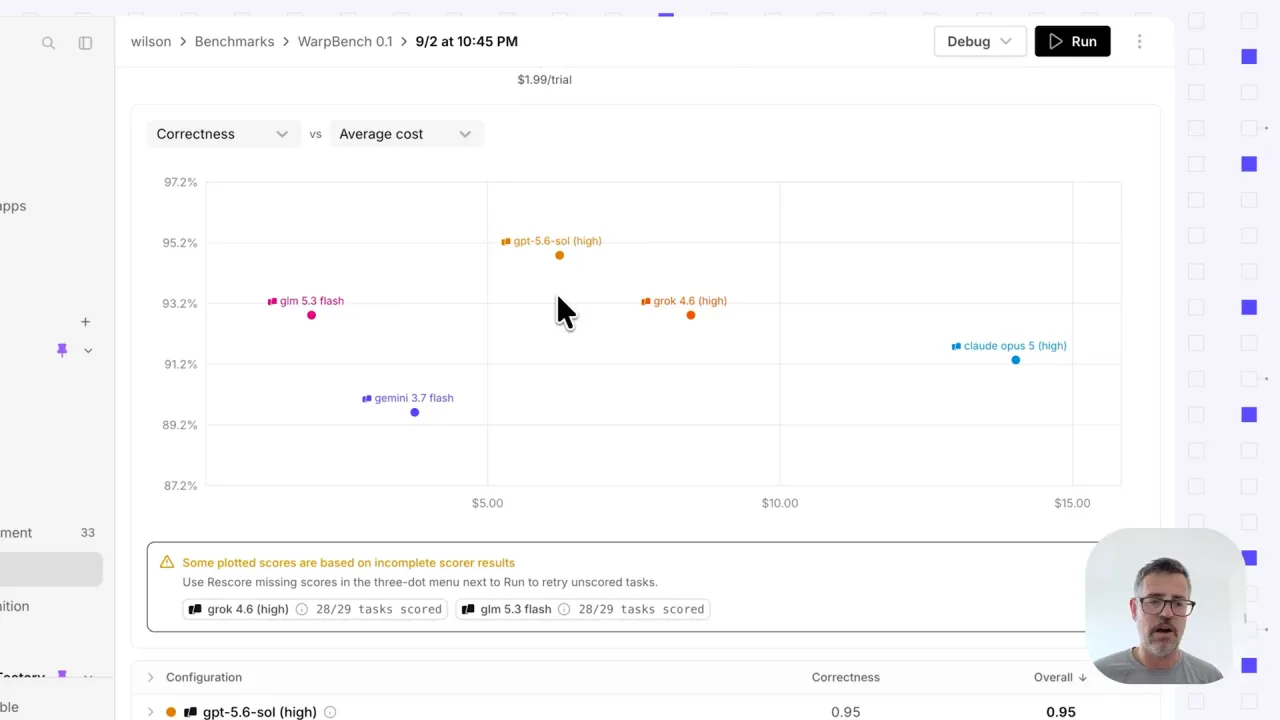
Still at 21:40 from Warp, “What it takes to build a software factory”.
WarpBench 0.1, run of 2 September. Correctness (y, 87.2%–97.2%) against average cost (x, about $0–15), read from the plot: gpt-5.6-sol (high) ≈ 94.8% at ≈ $6; glm 5.3 flash ≈ 92.8% at ≈ $2; grok 4.6 (high) ≈ 92.8% at ≈ $8.5; claude opus 5 (high) ≈ 91.3% at ≈ $14; gemini 3.7 flash ≈ 89.6% at ≈ $3.7. A warning notes grok 4.6 and glm 5.3 flash had 28 of 29 tasks scored. The table below lists gpt-5.6-sol (high) at 0.95 correctness.
Still vs. transcript: the narration names only the two Pareto candidates; the plot shows all five configurations, with the most expensive model (Opus 5) neither the most correct nor on the frontier for this task set.
5 · The factories stack
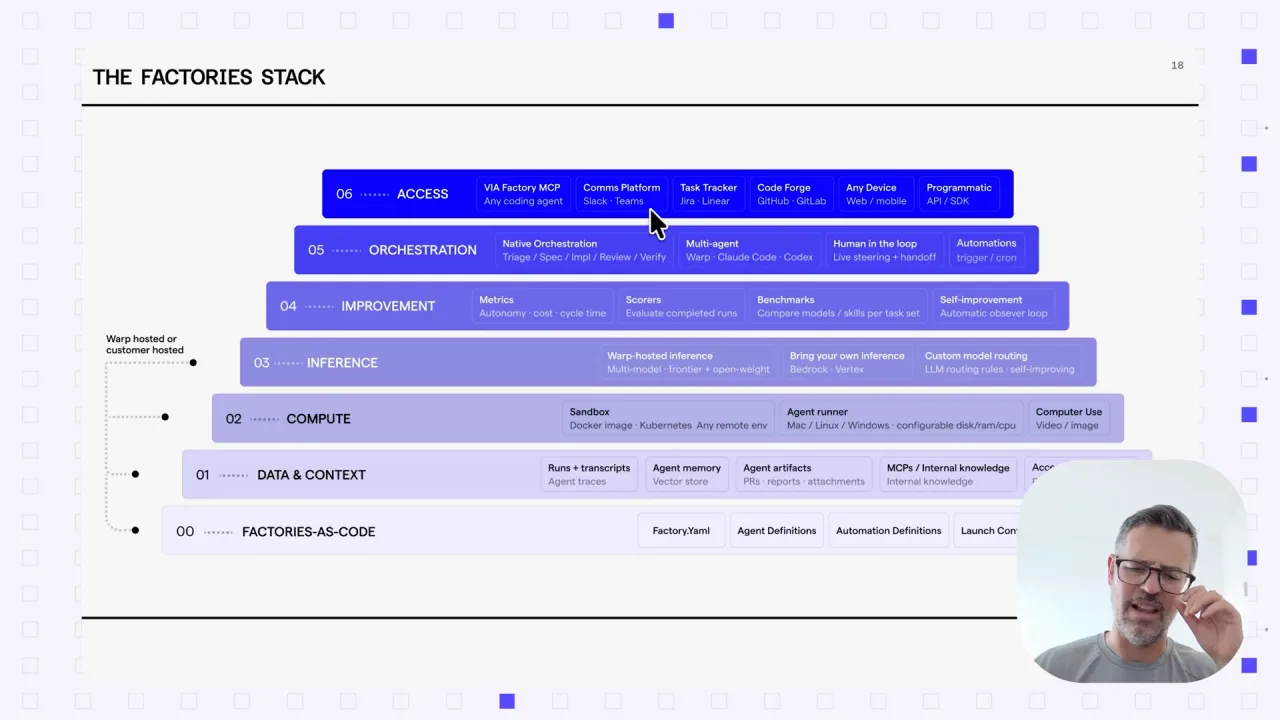
Still at 24:38 from Warp, “What it takes to build a software factory”.
| Layer | Components on the slide |
|---|---|
| 06 Access | Via Factory MCP (any coding agent) · Comms platform (Slack, Teams) · Task tracker (Jira, Linear) · Code forge (GitHub, GitLab) · Any device (web, mobile) · Programmatic (API, SDK) |
| 05 Orchestration | Native orchestration (triage / spec / impl / review / verify) · Multi-agent (Warp, Claude Code, Codex) · Human in the loop (live steering + handoff) · Automations (trigger / cron) |
| 04 Improvement | Metrics (autonomy, cost, cycle time) · Scorers (evaluate completed runs) · Benchmarks (compare models / skills per task set) · Self-improvement (automatic observer loop) |
| 03 Inference | Warp-hosted inference (multi-model, frontier + open-weight) · Bring your own inference (Bedrock, Vertex) · Custom model routing (LLM routing rules, self-improving) |
| 02 Compute | Sandbox (Docker image, Kubernetes, any remote env) · Agent runner (Mac / Linux / Windows, configurable disk/RAM/CPU) · Computer use (video / image) |
| 01 Data & context | Runs + transcripts (agent traces) · Agent memory (vector store) · Agent artifacts (PRs, reports, attachments) · MCPs / internal knowledge · (one item hidden by the speaker’s video) |
| 00 Factories-as-code | Factory.yaml · Agent definitions · Automation definitions · Launch config (cut off) |
Layers 00–03 are marked “Warp hosted or customer hosted.”
Still vs. transcript: the narration names the layers; the slide gives what goes in each, including the choice of hosted or customer-hosted for the lower four.
Dynamic-capabilities reading
digital-transforming/improving-digital-maturity— factory engineering as a managed capability: metrics, scoring, self-improvement and benchmarks applied to how software gets made.digital-seizing/balancing-digital-portfolios— model and harness choices made per task class from internal benchmarks, trading correctness against cost.
How it connects
- agent-harness — the factory as a harness defined in code, with its own improvement loop.
- agent-fleet-management — from scattered local agents to one governed fleet with fleet metrics.
- small-language-models — routing to the cheaper model when the benchmark shows it is close enough.
- ai-benchmarks — internal, replayed benchmarks instead of public ones.
- Chamath (8090) — another “software factory,” from the requirements side.
- McKinsey’s Explainer on AI costs — cost per successful outcome and routing, from the buyer’s side.
What was actually ingested
The full talk (25:51, length_seconds: 1551) from the human-curated caption track, fetched with yt-dlp after the transcript panel failed. A Gemini static scan found 54 visuals (149,997 tokens); five were verified against their pixels and published. Most of the rest are demo screens whose content the narration covers; still 53 (a recap slide) was dropped because its two-second display window caught a transition.
Linked entities and concepts
- agent-harness, agent-fleet-management, small-language-models, ai-benchmarks — updated in this ingest.
- dynamic-capabilities — the two cells tagged above.
Dangling (single-source mention, deferred): Zach Lloyd, Warp, Warp Factories.
Scope and reliability
A vendor’s talk and product demo on its own channel; Lloyd says so: “Obviously, I’m not unbiased here.” The headline results (cost per PR $55 to $15, +40% throughput, fewer reverts) are Warp’s own, without method; the dashboard shown is consistent with the cost figure. The benchmark is one 29-task suite on Warp’s work, two of whose configurations were incompletely scored. The value for this wiki is the concept of factory engineering, a concrete stack for it, and the practice of benchmarking models on one’s own recorded tasks.